
Quezon City, Philippines — The balance in the world is tilting irreversibly toward destruction beyond repair.
In 2026, the World Meteorological Organization reported that the last 10 years (2015-2025) were the hottest 11 years on record. With an average of 1.4 °C above pre-industrial levels, the worsening climate decline warrants emergency action.
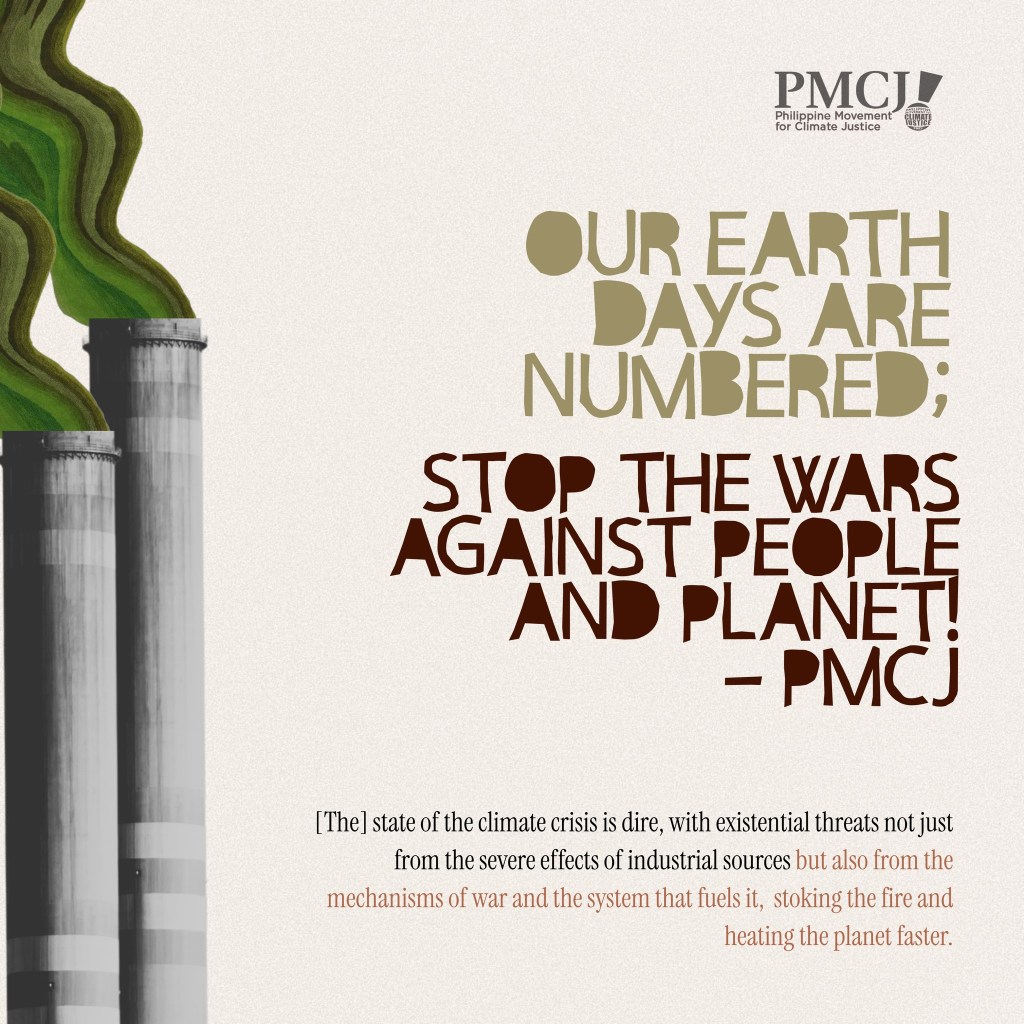
As the world celebrates another Earth Day this year, the state of the climate crisis is dire, with existential threats not just from the severe effects of industrial sources but also from the mechanisms of war and the system that fuels it, stoking the fire and heating the planet faster.
The deadly impacts of the US-Israel’s imperialist war in West Asia (Middle East) multiply daily, with world energy prices rising to unprecedented rates, along with every commodity and the cost of human living with it. In the Philippines, fuel prices have reached historic highs, triggering a transportation and energy crisis that the government is scrambling to address while refusing to admit. Electricity rates have also gone up, just as the country is hit by the yearly heatwave of the dry season. Inflation is also expected to rise, as the country’s import-dependent system is closely tied to oil prices.
Ian Rivera, PMCJ national coordinator, said, “The government has failed to provide any concrete solutions, nor any plans or roadmaps to alleviate the effects of the war or any external shocks affecting the country. Instead, they relied on relief aid and insultingly low cash disbursements and discounts for the transport sector, seemingly waiting for the crisis to blow over. It is clear that the Filipino people have been left to their own devices by their government, which refuses to lift the tax burden on each and every Filipino and make the solution impactful and long-term. Unless the solution addresses the very system that impoverished the people, everything will just be palliative.”
Meanwhile, significant windfall profits, estimated at about ₱46.5 billion in March alone, or about ₱1.5 billion every day, have been made possible by oil companies’ use of “replacement cost” pricing, according to a think tank.
The country’s reliance on fossil fuels as a source of energy has, time and again, exposed a crucial vulnerability of the country’s ability to cope with a supply crisis.
PMCJ Senior Energy Officer Larry Pascua said, “Had we invested earlier in renewable energy and actual transition instead of building infrastructures around a false transition with natural gas and imported fossil fuel, the country might have been standing on better ground during this crisis. Instead, the Department of Energy has now expressed that it is once again looking into returning to coal, mixed with RE, to cope with any LNG shortages or price hikes. The Department of Economy, Planning, and Development (DEPDev) has even outright called for the suspension of the coal moratorium, willingly suggesting to delay energy transition and advocating for more coal despite recorded communities and local environments’ destruction because of it.”
“Must we celebrate every Earth Day each year to call for the government to care for the environment? ‘Super El Niño’ has been predicted since last year and has now caused unlivable temperature conditions in some parts of the country. According to reports from the Food and Agriculture Organization and the World Meteorological Organization, agricultural productivity can drop by up to 50% during a single extreme heatwave. At the same time, farm workers are 35 times more likely to die from heat exposure than workers in other sectors. On land, this causes double-digit crop losses and mass livestock mortality, while at sea, it can disrupt the food chain, as happened in the marine heatwave of 2014-2016. Studies have also shown that for every 1°C increase in global warming, yields of major crops such as wheat can decrease by 4-10%,” explained Laica Rayel, PMCJ food, land, water, and climate (FLWC) senior campaigner.
Rayel highlighted that the same people breed the crises we experience. “We are dying because of the greed of these corporations, we are dying because of the government’s failures and its inept policies that destroy the environment, and we are dying because those with wealth and power refuse to take action that benefits anyone other than themselves and their rich allies,” she stressed.
The ongoing imperialist wars will not only directly worsen our already unbalanced state of climate but will also further destroy lives and communities around the world as they force the system to respond by raising the cost of commodities to survive. The selective impact of this crisis, which skews against the poor, only further exposes that this is not a system flaw, but the system working exactly as it is meant to–for the rich to get richer and the poor to make the rich get richer.
“The capitalist system that fuels the climate crisis, and the imperialist war of economic expansionism, and the way it has been played, allows for the already exorbitant cost that is essential human resources for survival to rise, which is the greatest threat to our continued existence on the planet. The abuse and exploitation of humans for the machinery of profit and domination also abuses the natural resources offered to us by our planet. The only way to truly save the planet is to change the system that kills the planet and its people for the sake of profit. The number of Earth Days we will celebrate is numbered, and if the system is allowed to continue any further, this year might be among the last of the Earth Days we will observe,” Rivera lamented. ###
For inquiries, contact:
Christian John P. Argallon
Junior Media and Communications Officer
Philippine Movement for Climate Justice
Email: cjargallon.comms@climatejustice.ph
For other PMCJ-related concerns, contact:
Sheila Abarra
Senior Media and Communications Officer
Philippine Movement for Climate Justice
mediacommunications@climatejustice.ph
Viber: +63-991-669-2356
WhatsApp: +63-938-089-8327
Read: https://www.facebook.com/share/p/1Di9CuWUAH/


![[Statement] MAG and UHC Collective statement on ES Recto asking for increased PHIC benefits for direct members](https://hronlineph.com/wp-content/uploads/2026/06/2592.jpg?w=940)
![[Press Release] Rights group denounces recent rights violations under Marcos Jr. | Karapatan](https://hronlineph.com/wp-content/uploads/2026/06/fb_img_1782195606708.jpg?w=1024)
![[Press Release] ATM condemns SLAPP suit against bishop, priest and anti-mining barricade leaders](https://hronlineph.com/wp-content/uploads/2026/06/fb_img_1782177936823.jpg?w=1024)
![[Statement] A public call to end Khurram Parvez’ arbitrary detenton | FIDH](https://hronlineph.com/wp-content/uploads/2026/06/c332f759869d6c11b02851c6bc73bf.jpg?w=1024)
 Human Rights Online Philippines
Leave a comment