
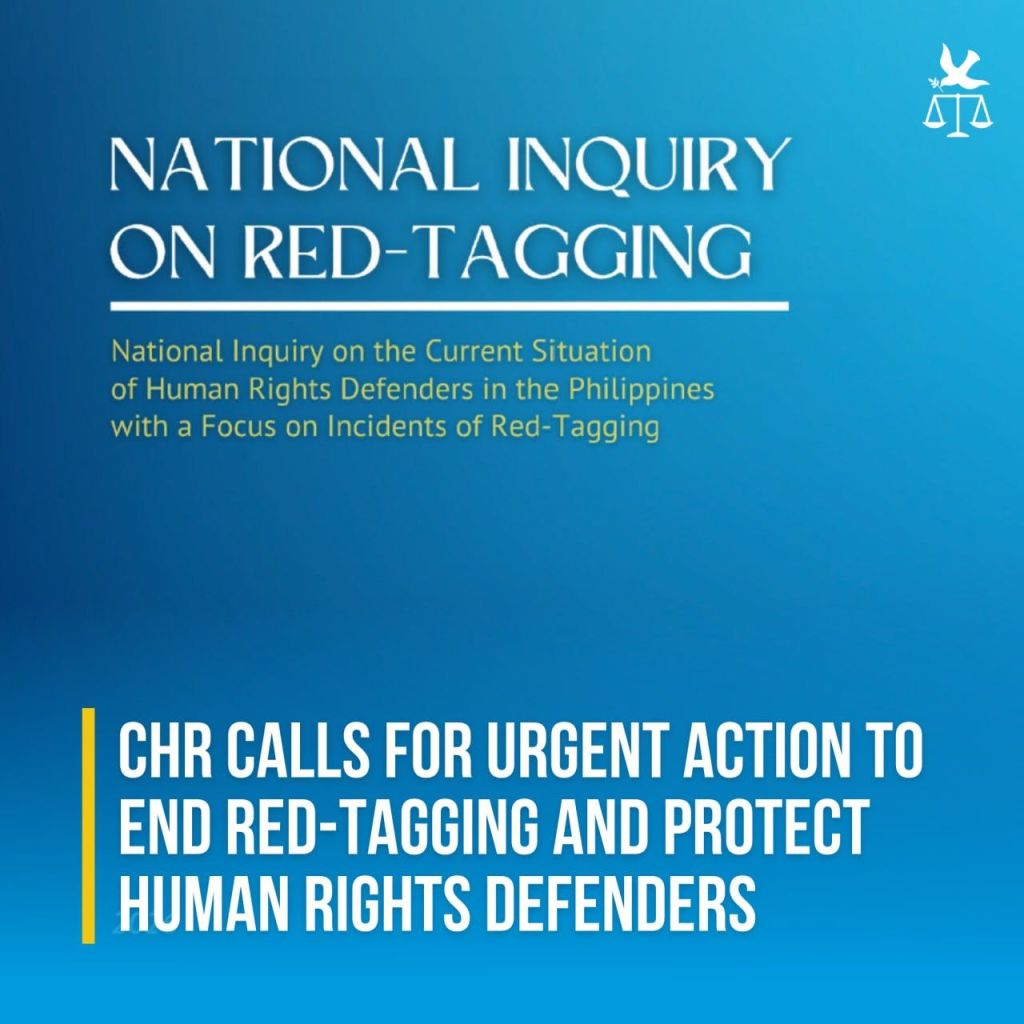
The Commission on Human Rights (CHR) reiterates its call to eliminate the practice of red-tagging and urges all branches of government to take urgent action to protect fundamental freedoms in the country.
The CHR’s findings and recommendations are drawn from the National Inquiry on the Current Situation of Human Rights Defenders in the Philippines with a Focus on Incidents of Red-Tagging conducted in 2025.
The Inquiry was conducted through a participatory, nationwide process, drawing from public hearings, sworn statements, and expert inputs from government, legal practitioners, civil society, and human rights defenders. Proceedings were held across Luzon, Visayas, and Mindanao to capture diverse experiences and perspectives, while recognizing limitations in participation and scope.
The Inquiry finds that red-tagging persists as a pattern of labeling individuals and groups as “communists,” “terrorists,” or “enemies of the State,” often without due process and through public and online platforms. Those affected include journalists, lawyers, students, labor leaders, Indigenous Peoples, and community organizers engaged in advocacy and civic work, as well as those voicing legitimate dissent on government policies.
The CHR underscores that red-tagging is not a harmless label. It creates a real and well-founded risk of harm. It exposes individuals to threats, harassment, and violence, and may serve as a precursor to grave human rights violations, including arbitrary detention, enforced disappearances, and extrajudicial killings.
The Inquiry further shows that red-tagging undermines the rights to life, liberty, security, expression, and association. It creates a chilling effect on dissent and weakens democratic participation. Despite existing legal remedies, the absence of a specific law penalizing red-tagging results in fragmented protection and limited accountability.
In response, the CHR calls for urgent and coordinated action across all branches of government.
The Executive is urged to adopt a comprehensive policy prohibiting red-tagging and to strengthen mechanisms that ensure prompt and impartial investigation of violations. The Legislative branch is called upon to enact a law that clearly defines and penalizes red-tagging, review existing counter-terrorism laws, and pass the CHR Charter to strengthen institutional protection. The Judiciary is encouraged to revisit and strengthen protective writs, such as amparo and habeas data, and to ensure timely access to justice for victims.
The Commission stresses that efforts to address security threats must remain anchored in human rights. Counter-insurgency and counter-terrorism measures must not come at the expense of fundamental freedoms.
“Addressing red-tagging requires sustained, coordinated, and rights-based action across all branches of government, as well as meaningful participation from civil society and other stakeholders,” the CHR underscores. “Ultimately, upholding the dignity, safety, and freedom of human rights defenders is integral to strengthening democratic space and the rule of law.”
Read the Executive Summary, Conclusions, and Recommendations here: https://bit.ly/CHRredtaggingreport2026.


![[Press Release] KAPATID to DOJ and COA: Take over CIW trust fund probe; restore missing funds to PDLs](https://hronlineph.com/wp-content/uploads/2026/09/3643.jpg?w=1024)
![[Statement] MAG and UHC Collective statement on ES Recto asking for increased PHIC benefits for direct members](https://hronlineph.com/wp-content/uploads/2026/06/2592.jpg?w=940)
![[Press Release] Rights group denounces recent rights violations under Marcos Jr. | Karapatan](https://hronlineph.com/wp-content/uploads/2026/06/fb_img_1782195606708.jpg?w=1024)
![[Press Release] ATM condemns SLAPP suit against bishop, priest and anti-mining barricade leaders](https://hronlineph.com/wp-content/uploads/2026/06/fb_img_1782177936823.jpg?w=1024)


Leave a Reply