
By Carlos Conde
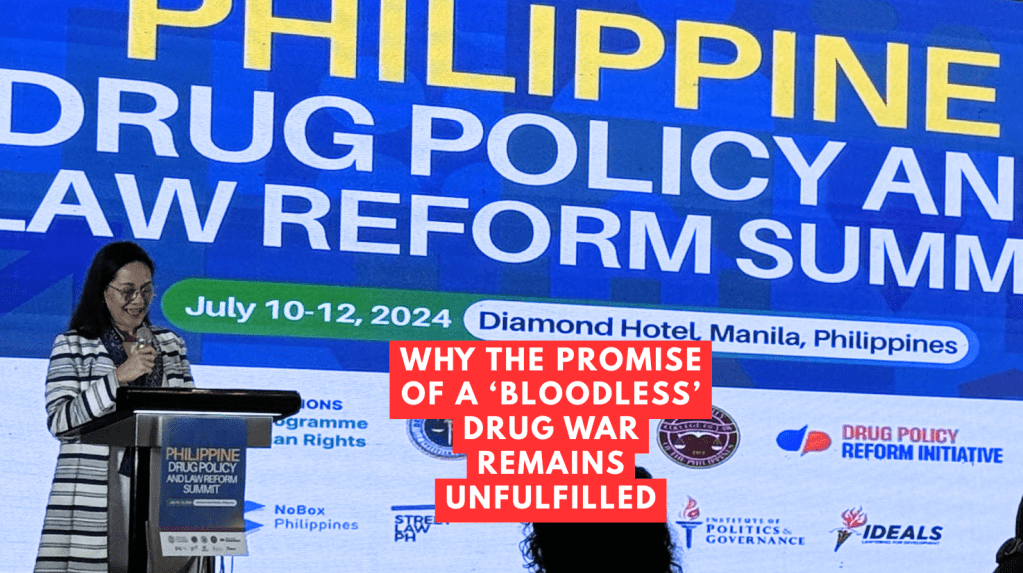
IN JULY 2024, inside the Diamond Hotel in Manila, Philippine government officials sat down with representatives from the United Nations, civil society, human rights defenders, health workers, and people directly affected by the drug war to talk about something the country had never formally discussed before: that the whole approach to the campaign against illegal drugs might be wrong.
The Philippine Drug Policy and Law Reform Summit — three days of testimony, position papers, and expert deliberation organized by the Department of Justice, the UN Office of Drugs and Crime, the Dangerous Drugs Board, and the UN Joint Programme on Human Rights — produced clear recommendations: overhaul the law, shift from punishment to public health, and put harm reduction at the center of the country’s response to illegal drugs.
Two weeks later, President Ferdinand Marcos Jr. delivered his State of the Nation Address but did not mention the summit once. He said, instead, that “extermination was never one of” his eight anti-drug principles. That was it. The most substantive discussion of drug policy reform in Philippine history was met with an absence and a shrug.
Now come the numbers, and they are not small. The Dahas Project of the University of the Philippines Diliman, which tracks every reported drug-related killing in the country by combing through local and national news every week, recorded more than 500 deaths since the summit up to March 2026.
Read more: https://rightsreport.org/2026/04/10/drug-war-continues/

![[Press Release] KAPATID to DOJ and COA: Take over CIW trust fund probe; restore missing funds to PDLs](https://hronlineph.com/wp-content/uploads/2026/09/3643.jpg?w=1024)
![[Statement] MAG and UHC Collective statement on ES Recto asking for increased PHIC benefits for direct members](https://hronlineph.com/wp-content/uploads/2026/06/2592.jpg?w=940)
![[Press Release] Rights group denounces recent rights violations under Marcos Jr. | Karapatan](https://hronlineph.com/wp-content/uploads/2026/06/fb_img_1782195606708.jpg?w=1024)
![[Press Release] ATM condemns SLAPP suit against bishop, priest and anti-mining barricade leaders](https://hronlineph.com/wp-content/uploads/2026/06/fb_img_1782177936823.jpg?w=1024)


Leave a Reply