
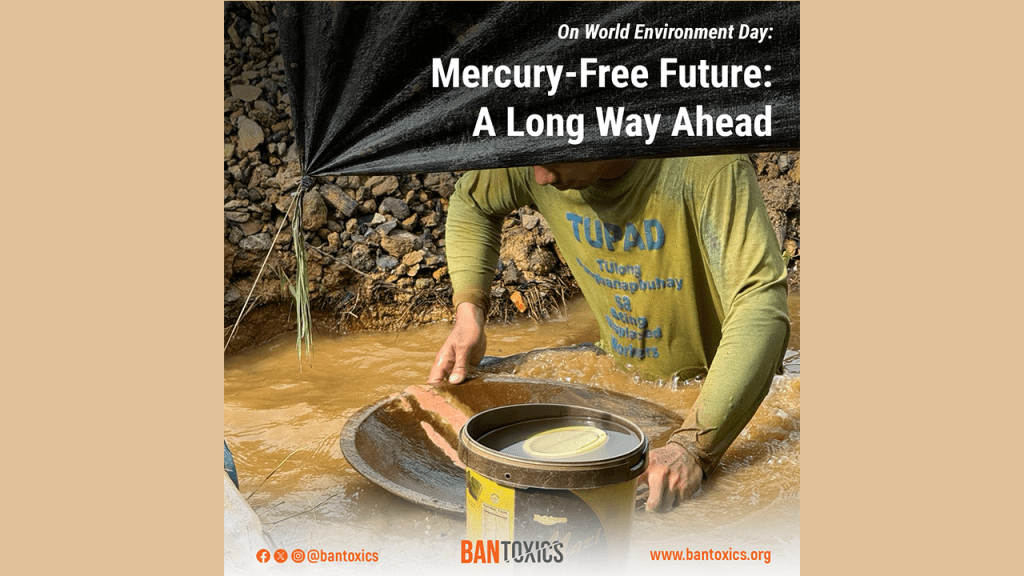
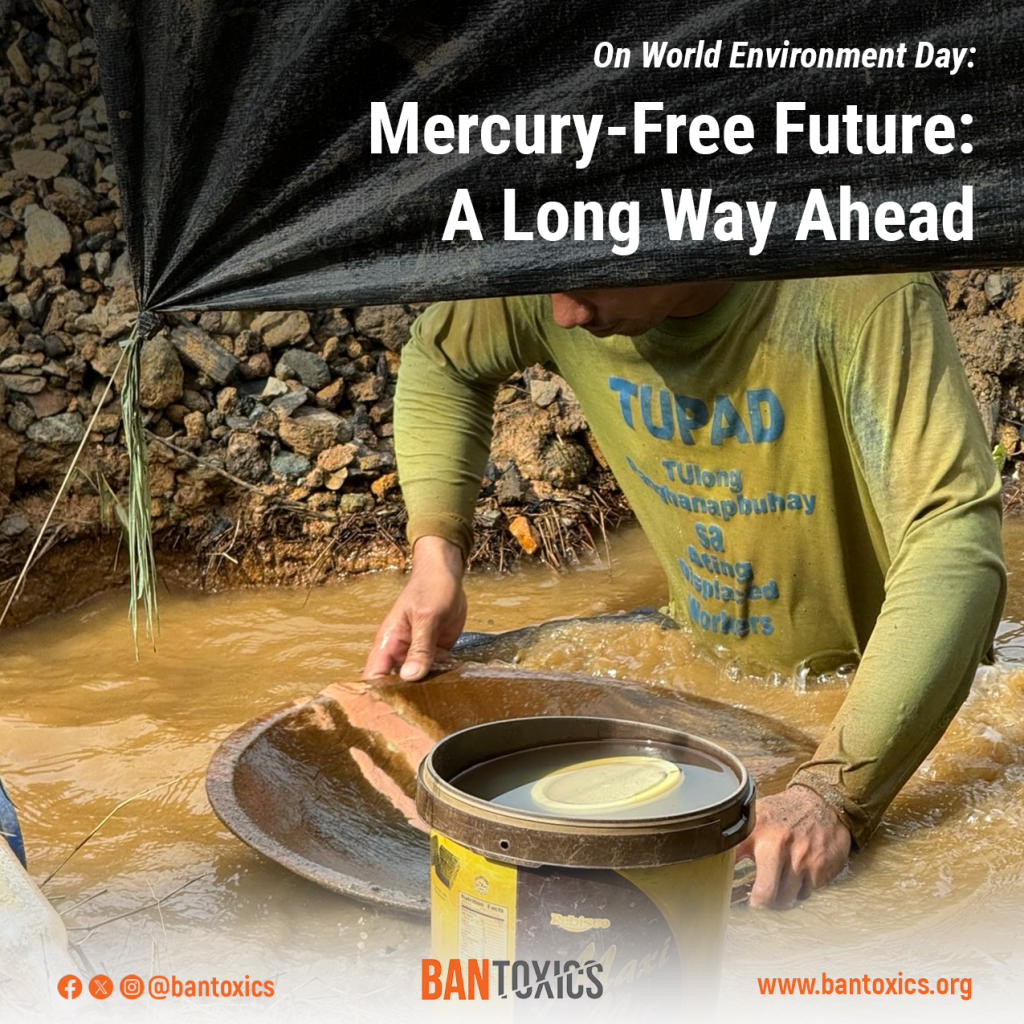
As the country celebrates World Environment Day, environmental watchdog group, BAN Toxics, draws attention to hard-hitting truths on the continued exposure of the Filipino people and the environment to toxic mercury.
Mercury is a neurotoxin that can cause irreparable damage to the nervous system. It is indestructible, its emissions and releases can accumulate, posing a significant threat to human health and the environment.
“While the Philippines has made significant progress in strengthening regulations to reduce mercury usage in order to protect vulnerable populations, disadvantaged groups and the environment from toxic effects, the work is far from over. We continue to face the illegal trade of mercury being used in artisanal and small-scale gold mining and the illegal sale of mercury-added skin-lightening products, mercury capsules for dental amalgam, and mercury-containing medical measuring devices in stores and e-commerce platforms,” said Jam Lorenzo, Policy Development and Research Officer of BAN Toxics.
The formalization of artisanal small-scale gold mining has progressed slowly. For instance, one mining association in Camarines Norte has been processing its permit for the declaration of Minahang Bayan and small-scale mining contract since 2014, spending more than 5 million pesos, and is still not completed.
With the price of gold hitting an all-time high in May, the demand for mercury has increased among small-scale miners who, despite the hazards of mercury use coupled with dynamite use, are forced to practice this risky livelihood to provide food on the table. Mercury, sold in pet bottles as high as 8,000 pesos per kilo, is easily bought in hardware stores in mining municipalities.
Recent market monitoring also reveals the sale of beauty creams laced with mercury in public markets and commercial establishments in urban centers across the country. BAN Toxics’ recent visits to Tacloban City, Tuguegarao, Daet and Metro Manila, showed the availability of FDA-banned Goree skin-whitening creams containing high levels of mercury. Similarly, unnotified and banned skin-whitening creams proliferate on e-commerce sites, with more than 1,000 sellers to date.
Mercury-added skin lightening products and mercury dental amalgam capsules continue to be available in both offline and online markets due to illegal transboundary trade and domestic sales. This persists despite global and regional regulations, fueled by limited law enforcement resources, consumer demand for cheaper options, and corruption.”
The group has documented sellers of mercury dental amalgam in dental supply stores in Manila and likewise monitored more than 35 sellers in both Lazada and Shopee platforms and in Facebook Marketplace.
Although mercury-containing medical measuring devices and fluorescent lamps are largely discontinued in healthcare facilities, the main challenge lies in mercury waste management, as mercury stockpiles remain improperly stored in some hospitals. The Philippine Healthcare and Mercury Waste Management project by UNIDO, in partnership with the DENR-Environmental Management Bureau and BAN Toxics, aims to address this issue over the next five years.
Along with stakeholders, the government must take stock of these persisting bottlenecks in order to meet its obligations under the Minamata Convention on Mercury. As we are to craft the National Action Plan for artisanal and small-scale gold mining, we urge regulatory bodies to meaningfully engage with local communities in decision-making processes and safeguard traditional livelihoods while developing accessible alternative and sustainable solutions to reduce the use of mercury in the sector.
Preventing the production, trade, advertising, and sale of mercury-added products in the country needs a multifaceted strategy, including the implementation of robust regulations and enforcement policies and regional cooperation.
“We reiterate our call on the government to improve our regulatory agencies’ capacity for market surveillance, enforcement, product inspection and analysis, as well as detection capabilities, to effectively curb the widespread trade of products containing toxic chemicals,” the group added.
The Minamata Convention on Mercury will celebrate its seventh anniversary this year; the Philippines ratified it in 2017. #
Media Contact:
Thony Dizon
Toxics Campaigner, BAN Toxics
0917-8322616



![[Press Release] ATM pushes for AMBB to replace Mining Act](https://hronlineph.com/wp-content/uploads/2026/04/675371480_938711918788021_8181199381954425887_n.jpg?w=1024)
![[Press Release] On Earth Day 2026: Green Groups Clamor for Accountability over Toxic Landfill Fire, Demand Sustainable Solutions to Prevent and Reduce Waste | Ecowaste](https://hronlineph.com/wp-content/uploads/2026/04/photo-courtesy-of-navotas-city-mayor-john-rey-tiangco.jpg?w=768)
![[Press Release] Our Earth days are numbered; stop the wars against people and planet! | PMCJ](https://hronlineph.com/wp-content/uploads/2026/04/672439156_1399038548927184_3596699151074925929_n.jpg?w=1024)
![[In the News] Teachers Press Government for P15,000 Pay Hike | TDC](https://hronlineph.com/wp-content/uploads/2026/04/674244719_1397734859055498_7139482499278154965_n.jpg?w=1024)
 Human Rights Online Philippines
Leave a reply to Liza Cancel reply