
By Fr. Shay Cullen, Founder since 1974
On April 24, historical researcher Dana Lee made at the Manila Elks Club in Makati City a presentation on the history — and current situation — of the thousands of teenage girls and young women who were abducted and forced into sex slavery by the Japanese Imperial Army from 1932 to 1945. These girls and women across Asia who were forced to sexually service Japanese troops during World War II were called “comfort women.”
While only a few of them are still alive today, there is a strong interest among advocates to keep alive the record of what they had suffered. Lee’s presentation was part of a three-day event that also discussed the ongoing pursuit for justice for the comfort women and for the Japanese government to formally apologize to them. The groups Malaya Lolas and Lila Pilipina continue to keep that issue alive, as is Lee. Stories about these women are still being told and shared on social media and in documentaries.
In 2017, Chinese-Filipino civic organization Tulay Foundation and the National Historical Commission of the Philippines unveiled in Manila a statue to memorialize the comfort women. It caused an uproar, with the Japanese embassy here demanding an explanation. In response, the Philippine government removed the statue months later. On March 8, 2023, the United Nations’ Committee on the Elimination of Discrimination against Women (Cedaw) ruled that the government failed to provide adequate reparation and support to the surviving Filipino comfort women. It recommended that the government provide them with “full reparation, including recognition and redress, an official apology and material and moral damages, for the continuous discrimination that they suffered.”
In 1996, UN researchers called the crimes against the comfort women “crimes against humanity.” The United States Institute for Peace said these former sex slaves could have been as many as 500,000. The UN has called for an official apology, material compensation, and the inclusion of their history in schools. Following the Cedaw ruling, the government acknowledged the comfort women’s suffering, and in May 2023, President Ferdinand Marcos Jr. directed agencies to extend assistance to the Malaya Lolas and address the UN’s findings.
Most of the comfort women died of disease, malnutrition or suicide, or from violence, before the end of the war. Those who survived kept their wartime ordeal a secret for fear of rejection and discrimination.
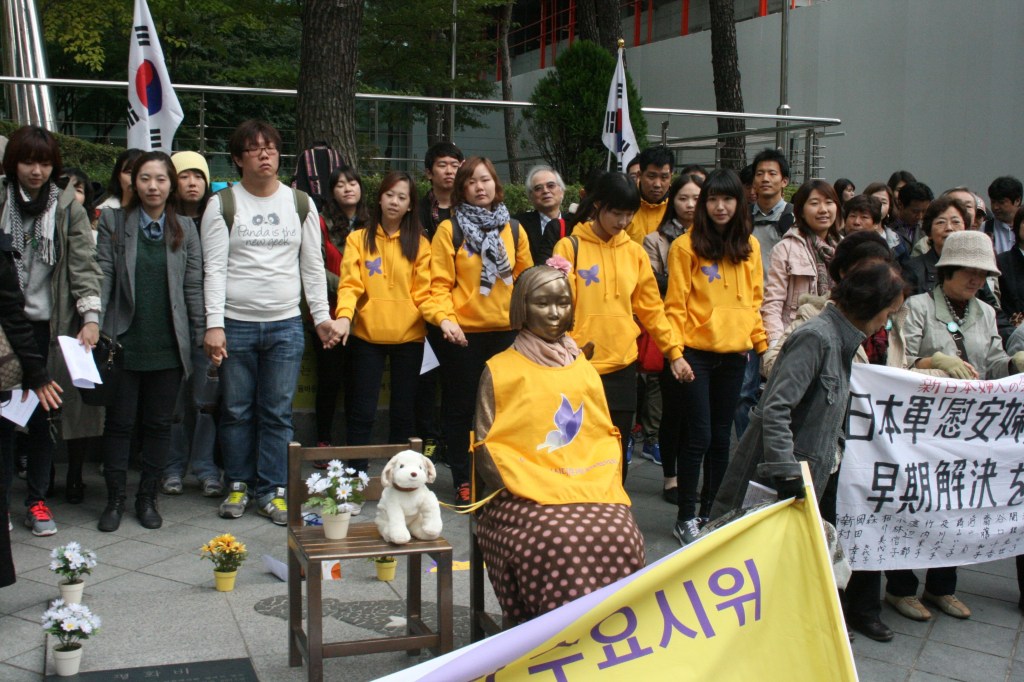
In South Korea, as many as 200,000 women and girls were forced into sex slavery by the Japanese army during Tokyo’s occupation of the Korean peninsula. UN researchers learned in 1996 that these women suffered dehumanizing treatment that also amounted to “crimes against humanity.” They have been the most vocal about demanding justice. This writer once went to South Korea to join a street protest on the matter and greet the survivors beside a statue of a child facing the Japanese embassy in Seoul — a symbol of the thousands of these abused women and girls.
Settlements
Between 1995 and 2007, the Japanese government set up the Asian Women’s Fund (AWF) for victims of the war, made up of public resources and donations from Japanese citizens. Beneficiaries also received apologies from individual state officials. In those years, the AWF made “atonement” settlements with the victims. In the Philippines, almost 211 survivors received payments; 61 in South Korea; and 13 in Taiwan. Each received an individual payment of 2 million yen (approximately $18,000) from private donations. A total of 285 survivors agreed to the payments.
The women also received medical and social support services paid for by the Japanese government. Several prime ministers — Ryutaro Hashimoto, Keizo Obuchi, Yoshiro Mori, and Junichiro Koizumi — sent signed letters of apology and remorse to survivors who accepted the compensation from the AWF. Another premier, Shinzo Abe, expressed “most sincere apologies and remorse” through a statement read by then-foreign minister — and future prime minister — Fumio Kishida, hoping for a “final and irreversible” resolution. Despite this, women activists and support groups for survivors continue to highlight the issues, as they did at last week’s Elks Club event.
After the end of World War II, a new form of women’s exploitation was set up by the Japanese government with the approval of the occupying United States authorities. This time, the “comfort stations” were replaced with an organized system of brothels, into which Japanese women were trafficked, coerced or tricked, that were designed specifically for American soldiers to prevent the women from being raped. They were named “special amusement facilities” and organized by the Recreation and Amusement Association. While the US military did not technically run the sex dens, they allowed them to exist and, in many cases, provided medical inspections to keep the women “safe” from venereal diseases. This lasted a few years until the system was banned due to rising venereal disease rates and an outcry from women’s groups.
Conditions for the women caught in this were brutal and harsh; some were forced to service up to 60 soldiers a day. Eventually, pressure from American women’s groups and a report from then-general Douglas MacArthur’s staff that highlighted the brutalization of these women brought this system of organized sexual exploitation to an end.
In the Philippines, the sex industry was encouraged to satisfy the urges of US troops, especially during the Korean War (1950–1953) and later, the Vietnam War (1955–1975). Thousands of US soldiers poured into American bases at Clark and Subic Bay, and huge sex industries in Angeles City and Olongapo City were allowed to thrive for the men to have unlimited sexual access to women. As a result, drug and child sexual abuse, venereal diseases, HIV-AIDS, and violent crime were common.
This was the start of human trafficking and sexual slavery in the sex bars and clubs. The young girls were recruited from the poorest provinces through promises of good jobs in hotels. Small advance payments were made to the parents and the girls were “indentured” to the sex bars. They were forced to be sex workers — the new name of “comfort women” — and are held in “debt bondage” — the new name for sex slavery. There was no escape; they either stay or go to prison for not paying their debts.
As a result, sex trafficking is the scourge of Southeast Asia. It is a major crisis; an estimated 200,000 to 225,000 women and children are trafficked annually, constituting nearly one-third of global trade. The Philippines serves as a primary source country, with 60,000 to 100,000 children involved in sexual exploitation, ranking among the highest globally for online sexual abuse. The UN Children’s Fund said that in 2021 alone, 2 million children in the Philippines were subjected to online sexual abuse and exploitation. Children reported that they experienced grooming and received offers of gifts or money in exchange for sexual acts. Some were threatened or blackmailed to engage in them. Due to stigma, disclosure is disproportionately low, despite various reporting channels. This current form of exploitation is rooted in war and the “comfort women,” and children today are the victims of endless wars that benefit the billionaires behind the industrial military complex and their investors.
END.
Read: https://preda.org/comfort-women-and-modern-sex-slavery/

![[Press Release] KAPATID to DOJ and COA: Take over CIW trust fund probe; restore missing funds to PDLs](https://hronlineph.com/wp-content/uploads/2026/09/3643.jpg?w=1024)
![[Statement] MAG and UHC Collective statement on ES Recto asking for increased PHIC benefits for direct members](https://hronlineph.com/wp-content/uploads/2026/06/2592.jpg?w=940)
![[Press Release] Rights group denounces recent rights violations under Marcos Jr. | Karapatan](https://hronlineph.com/wp-content/uploads/2026/06/fb_img_1782195606708.jpg?w=1024)
![[Press Release] ATM condemns SLAPP suit against bishop, priest and anti-mining barricade leaders](https://hronlineph.com/wp-content/uploads/2026/06/fb_img_1782177936823.jpg?w=1024)


Leave a comment