
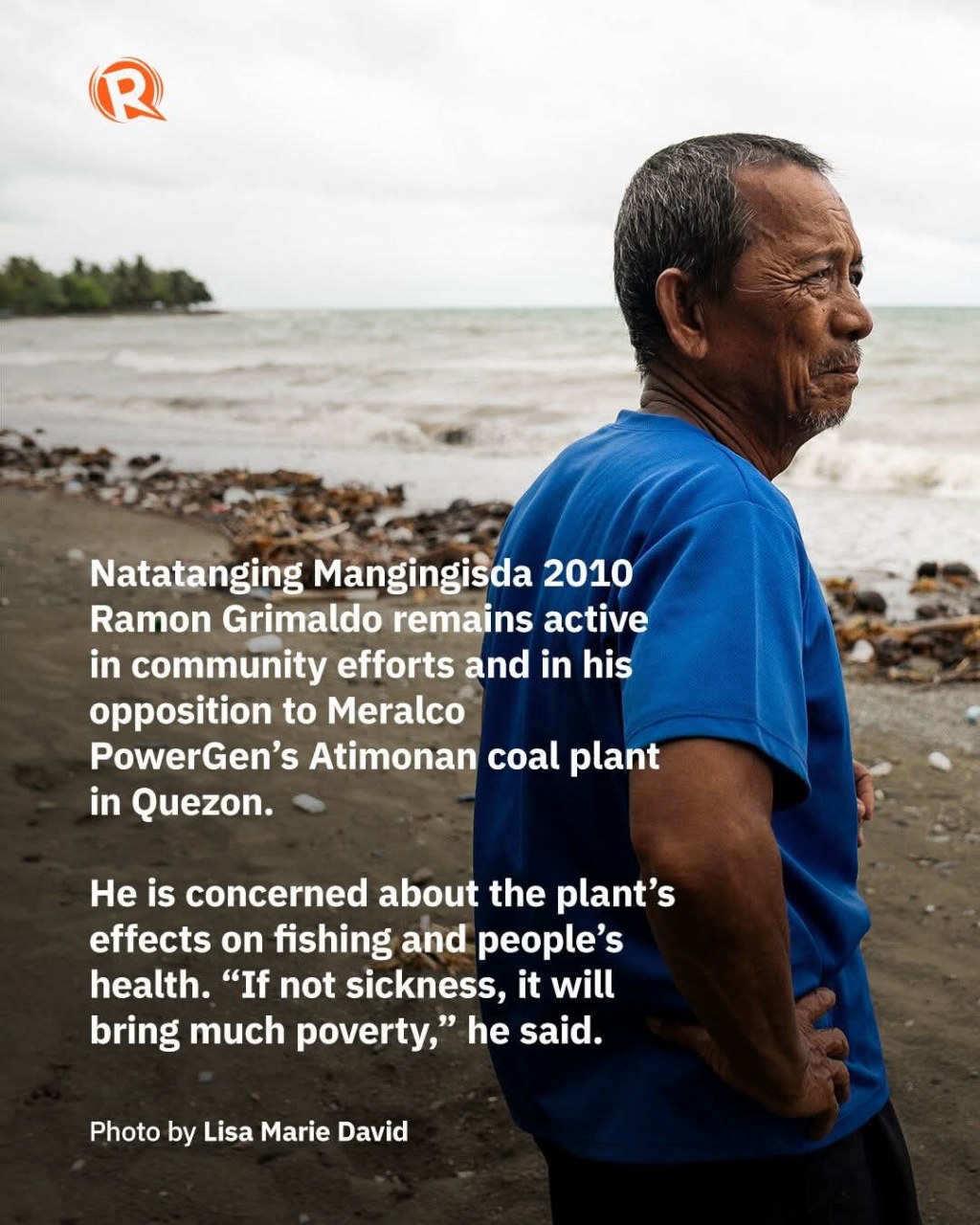

Down south of Luzon island lies a village overlooking Lamon Bay, home to less than a thousand residents. Father Warren Puno, a 47-year-old parish priest in Quezon province, stood on a small boat sailing the rough waters of the bay.
It was raining and his clergy shirt was soaked. He took photos and videos of the revetment wall contouring the face of the low-lying mountains. The wall was built in preparation for a 1,200-megawatt coal-fired power plant.
Puno was sailing to get to the bayside village called Villa Ibaba, the host community of the coal plant. Villa Ibaba is located around seven kilometers from the town center of Atimonan in Quezon.
It has been 10 years since Puno was assigned in Atimonan as an assistant parish priest. When he came to town in 2015, he didn’t know much about climate change. But he volunteered in relief operations in Super Typhoon Yolanda’s aftermath in November 2013. He saw the dead in Tacloban.
Atimonan is a quiet town. Puno said he used to share a drink with the people from Villa Ibaba and in doing so has become well-versed in their stories. That they shy away from conflict, that they have half a mind on the proposed coal plant in their village, are things the priest has grown accustomed to.
Puno recalled: “When we came here, this is what they usually told us back in 2015: ‘We can’t do anything, Father. It’s a done deal.’”
That same year, different churches in Quezon staged the first mobilization in Atimonan against the coal plant. And people showed up. They may have been silent, said Puno, but their actions spoke otherwise.
https://www.facebook.com/share/17HaDedUdr/

![[Statement] Statement of Condemnation to Quezon City 4th District Representative Bong Suntay on his Sexist and Objectifying Remarks | Miriam College – WAGI](https://hronlineph.com/wp-content/uploads/2026/03/fb_img_1772616021222.jpg?w=1024)
![[In the news] Pangasinan town nuke plan faces backlash | INQUIRER.net](https://hronlineph.com/wp-content/uploads/2026/02/screenshot-2026-02-09-143816.png?w=1024)
![[From the web] CHR backs stiffer penalties for hospital detention, urges focus on institutional accountability](https://hronlineph.com/wp-content/uploads/2026/02/627076470_1309237347897513_1019273190179875576_n.jpg?w=1024)
![[Press Release] PAHRA raises alarm over proposed social media registration, flags risks to free expression](https://hronlineph.com/wp-content/uploads/2026/02/fb_img_1770262130079.jpg?w=1024)
 Human Rights Online Philippines
Leave a comment