
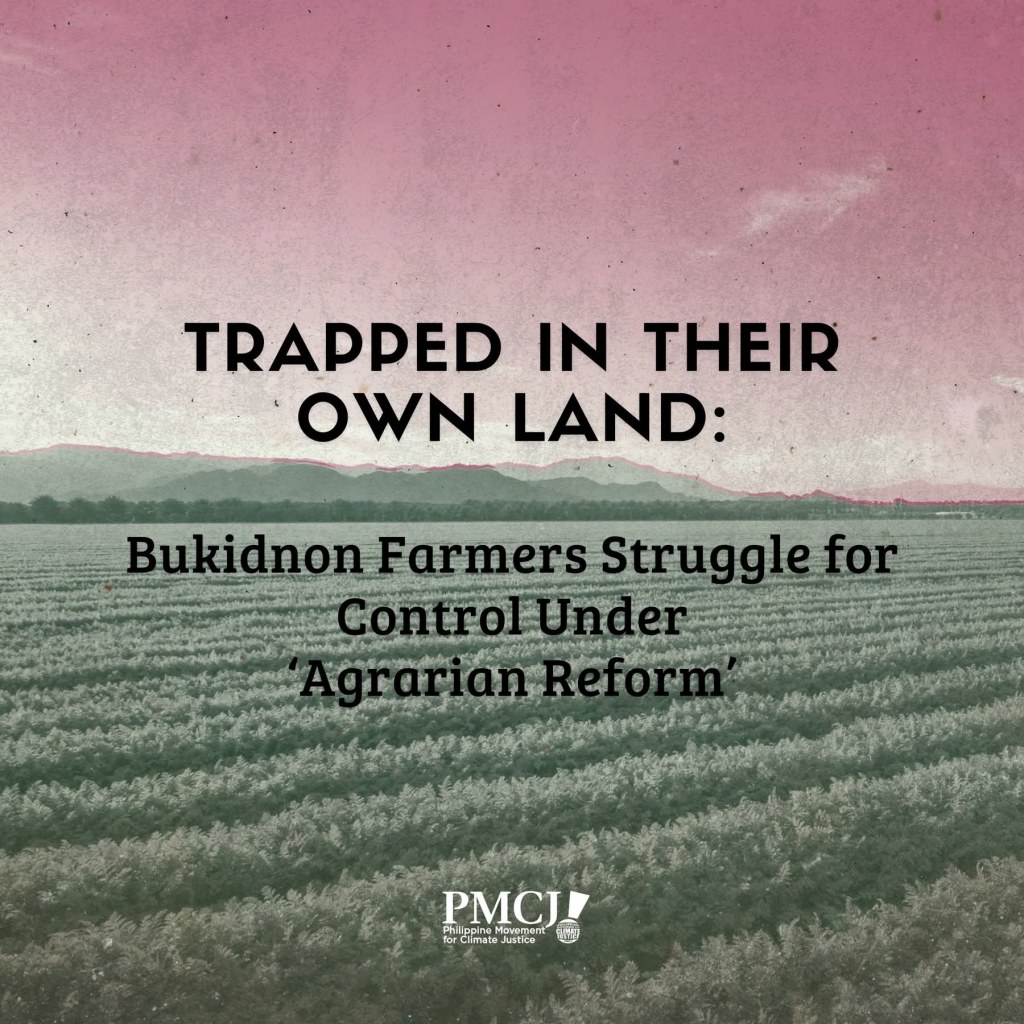
From a distance, fields of pineapple in Bukidnon look like a success story of agrarian reform. Vast plantations stretch toward the horizon, producing crops for global markets.
On paper, many of these lands are already “owned” by farmers, awarded under the Comprehensive Agrarian Reform Program (CARP). But for beneficiaries like Nora (not her real name), ownership has not translated into actual use or a decent living.
“Wala man koy mabuhat, kay ang presidente sa coop man mao ang ga buot [I cannot do anything, because the president of the cooperative is the one who decides],” Nora said. She is a beneficiary of a Collective Certificate of Land Ownership Award (CLOA), a land title issued to farmer groups or cooperatives rather than individuals.
“Gusto ko unta mag-uma, kay mas dako man ang akong kitaon [I want to farm, because I would earn more],” she added. “Pila ra man na ang tinuig nga bayad gikan sa Del Monte kumpara sa ako gyud ang mag-uma [What is the yearly payment from Del Monte compared to if I farmed the land myself].”
Like many farmers in Bukidnon, Nora’s land is tied to a lease arrangement with Del Monte Philippines and its contract growers—an arrangement she has little power to challenge.
Collective titles, a pre-condition for landowners’ continuing control
Collective CLOAs were introduced by the government as a stopgap measure, meant to fast-track land distribution in contentious or corporate-dominated areas. Instead of distributing individual titles, land was awarded to cooperatives or associations, with the assumption that farmers would later transition to individual ownership. In practice, this transition rarely happens.
Collectivization, or the issuance of collective CLOAs, was one of the achievements that the Philippine peasant groups introduced in the agrarian law right after the EDSA people’s uprising. Peasant groups drew lessons from the successful collectivization done by other states in implementing agrarian reform.
There are Israel’s kibbutzim and moshavim, considered the most successful type of collectivization in the world. There is the China’s Household Responsibility Program implemented during the post-1978 Reforms. Denmark has its Agricultural Cooperative Program, which increased farm yields and productivity through collectivization. Then there is Vietnam’s post-1986 Renovation, during which the country shifted from strict collective farming to a model that encouraged private initiative while keeping the state in control of land ownership. This resulted in significant growth in agricultural production. All these success stories of states’ farm collectivization point to the science of economies of scale. The difference is that surplus value is democratized, since agricultural monopolies are already dismantled, and the state avoided coercion in pushing for collectivization.
But in the Philippines, under the Comprehensive Agrarian Reform Law, where collectivization prevails rather than empowering farmers and ensuring economic emancipation, the practice is quite the opposite. Based on the 10-year research of MAKABAYAN-Pilipinas in Mindanao, a national peasant organization, and the Don Carlos Bukidnon Farmers Association (DCBUFAI), collectivization under the cooperative scheme is premised on a leaseback or joint venture agreement (JVA) with an agribusiness corporation, which more often than not, are the former landowners of the CARP lands. Land distribution becomes a business transaction between the agribusiness corporation that engages in agricultural production, the landowners who maintain land monopolies for agribusiness, and land agents operating surreptitiously within government offices.
A collective CLOA will not be processed unless the cooperative or the farmers’ association agrees to enter into a leaseback, a lease agreement, or a JVA. Coercion still exists in CARP, but this time, in continued favor of the landowning class.
According to legal guidelines on collective CLOAs, the lack of individual titles “restricts beneficiaries’ capacity to exercise full ownership rights,” undermining the very goals of agrarian reform. Instead of empowering farmers, the system often consolidates power in the hands of cooperatives and corporate partners.
Lessons from the past, repeating in the present
This is not a new problem in Bukidnon. Historical reporting has documented how similar arrangements effectively placed land control in the hands of cooperatives aligned with Del Monte, leaving farmers with meager incomes. In some past cases, beneficiaries reportedly earned as little as ₱25,000 per hectare per year—an amount far below the poverty threshold and insufficient to sustain a household.
Today, many farmers remain locked in 10-year lease agreements with contract growers. These deals, commonly structured around pineapple production, offer fixed annual payments but little security. Farmers bear the risks of market fluctuations and environmental damage, while corporations maintain control over land use and profits.
For beneficiaries, the choice is often illusory: accept the lease, or risk losing access to any income at all.
Land rights as a climate justice issue
For the Philippine Movement for Climate Justice (PMCJ), the situation in Bukidnon is not only an agrarian issue—it is a climate justice issue.
PMCJ’s Food, Land, Water, and Climate (FLWC) campaign underscores how the absence of land tenure deepens farmers’ vulnerability to climate impacts. Without ownership and control over their land, farmers cannot diversify crops and increase their incomes, adopt climate-resilient practices, or prioritize food for local consumption.
“Climate justice cannot be achieved without addressing the systemic inequities in land ownership and agricultural policy that leave farmers vulnerable to both economic exploitation and environmental hazards,” said Daisy Aballe, senior Mindanao campaigner on FLWC. “True climate solutions must involve equitable land tenure, food sovereignty, empowerment of small farmers, and ending the centuries-old landlessness.”
PMCJ also points to the broader context of agribusiness operations in Mindanao, where land dispossession, environmental degradation, and repression have long accompanied large-scale plantations. As climate change intensifies floods, droughts, and crop losses, farmers who lack land control are left with few options to adapt.
Calls for reform beyond symbolism
PMCJ, together with farmers’ groups and allies, urgently calls for the immediate review of lease arrangements that strip agrarian reform beneficiaries of real control over their land. According to the group, these schemes perpetuate poverty while undermining food security and community resilience.
Ian Rivera, PMCJ national coordinator, stressed the urgency of completing the agrarian reform program, correcting the mistakes of past land reform laws, and ensuring that a genuine transfer to the actual tillers actually happens. Collectivization, drawing on the successful lessons of other countries, can hasten land distribution and avoid the administrative costs of individual titling. While individual titling is still the direction, DAR and DA must first work with farmers to ensure their actual ownership and control of the land, and to provide the necessary agricultural mechanization, subsidies, and technology for production.
“Land justice is climate justice,” Rivera said. “When farmers are denied land rights, we weaken food security and leave communities more vulnerable to the climate crisis and the country with a food crisis. We cannot survive by food importation.”
For farmers like Nora, the struggle is deeply personal. Owning land in name but not in practice means being trapped. They are unable to farm, unable to decide, and unable to break free from contracts that favor corporations over communities.
As Bukidnon continues to feed Del Monte’s global supply chains, affected farmers ask a simple question: when will agrarian reform finally mean control over their own land and a future they can shape? ###
Read more: https://docs.google.com/document/d/156H3QUFxZe85qAW9an6UUmL6cOsm_yUHBd8ASQjKRnQ/edit?usp=drivesdk
https://www.facebook.com/share/p/1GYyM9BAAV/
FOR INQUIRIES:
Pat Pangantihon
Policy and Communications Officer-Mindanao
Philippine Movement for Climate Justice
pjpangantihon.mindanao@climatejustice.ph


![[Statement] Statement of Condemnation to Quezon City 4th District Representative Bong Suntay on his Sexist and Objectifying Remarks | Miriam College – WAGI](https://hronlineph.com/wp-content/uploads/2026/03/fb_img_1772616021222.jpg?w=1024)
![[In the news] Pangasinan town nuke plan faces backlash | INQUIRER.net](https://hronlineph.com/wp-content/uploads/2026/02/screenshot-2026-02-09-143816.png?w=1024)
![[From the web] CHR backs stiffer penalties for hospital detention, urges focus on institutional accountability](https://hronlineph.com/wp-content/uploads/2026/02/627076470_1309237347897513_1019273190179875576_n.jpg?w=1024)
![[Press Release] PAHRA raises alarm over proposed social media registration, flags risks to free expression](https://hronlineph.com/wp-content/uploads/2026/02/fb_img_1770262130079.jpg?w=1024)
 Human Rights Online Philippines
Leave a comment