
January 20, 2026
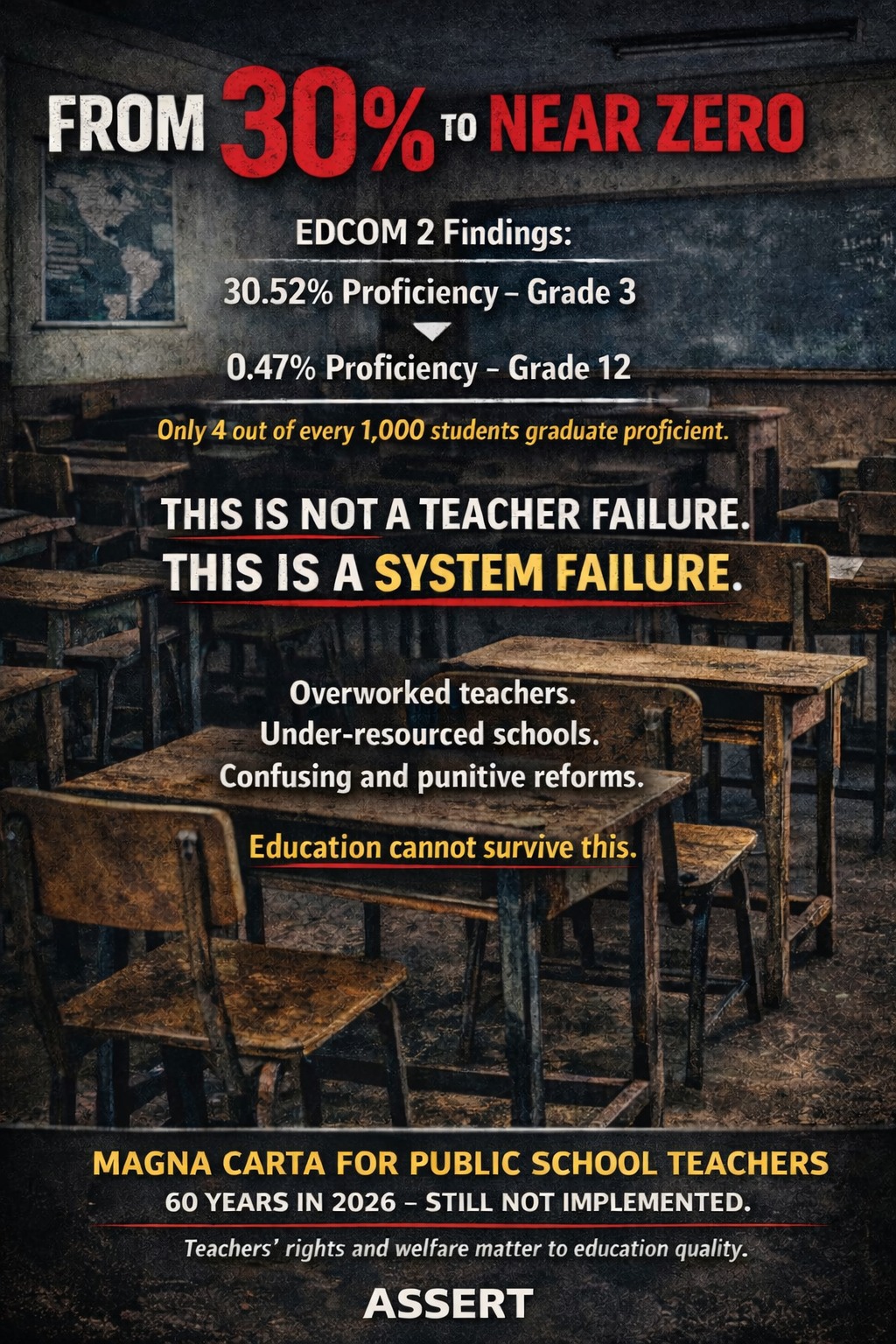
The Action and Solidarity for the Empowerment of Teachers (ASSERT) expresses grave concern over the recently released findings of the Second Congressional Commission on Education (EDCOM 2) showing a dramatic decline in student proficiency across grade levels—from 30.52% in Grade 3 to a near-zero 0.47% by Grade 12.
This data indicates that while many Filipino learners begin schooling with basic foundational skills, only four out of every 1,000 Senior High School graduates demonstrate the analytical and problem-solving competencies expected at the end of basic education. This is not a marginal issue—it signals a deep and systemic failure of public basic education.
A Crisis Teachers Have Long Raised
While these figures have shocked the public, ASSERT emphasizes that they are not new to teachers, school heads, parents, or learners. For years, educators have warned of widening learning gaps, overcrowded classrooms, excessive workload, inadequate resources, and reforms that fail to improve actual teaching and learning conditions.
The EDCOM 2 findings merely confirm what has long been visible on the ground: the education system is unable to sustain learning across grade levels.
Years of EDCOM 2 Findings—But Where Is the Impact?
EDCOM 2 has existed for almost three years, generating studies and recommendations aimed at reforming the education sector. ASSERT raises a fundamental question:
After all these findings, where are the decisive, system-wide actions?
Teachers continue to face:
- Heavy teaching loads and expanding non-teaching tasks
- Large class sizes
- Insufficient learning resources and support staff
- Increasing pressure from compliance-driven and punitive policies
This compels us to question how EDCOM 2 recommendations are being acted upon by the Department of Education (DepEd)—and whether these are shaping real change or remaining largely rhetorical.
Teacher Demoralization Is a Systemic Outcome
Despite the continuous rollout of reforms, teachers’ working conditions have not significantly improved. Administrative demands continue to grow, directives often overlap or contradict each other, and accountability mechanisms increasingly rely on fear rather than support.
Instead of being encouraged to teach and lead, many teachers and school heads feel harassed, overburdened, and demoralized. A growing number remain in service not out of fulfillment, but simply until retirement. This widespread dissatisfaction directly undermines teaching quality and learner outcomes.
The Long-Standing Non-Implementation of the Magna Carta
ASSERT stresses that the learning crisis cannot be separated from the persistent non-implementation of the Magna Carta for Public School Teachers, which will mark its 60th anniversary in June 2026.
Six decades after its enactment, this landmark law—which comprehensively guarantees teachers’ rights, welfare, academic freedom, security of tenure, reasonable workload, and participation in policy-making—remains largely unimplemented in practice.
The Magna Carta was designed precisely to:
- Protect teachers from excessive workload and unreasonable assignments
- Ensure fair compensation, benefits, and working conditions
- Safeguard teachers’ professional dignity and well-being
Its continued neglect has deprived teachers of protections that could significantly improve morale, retention, and motivation, and consequently enhance the quality of education delivered to learners.
ASSERT firmly asserts that no education reform can succeed while a foundational law protecting teachers remains ignored.
Digitalization Without Infrastructure Deepens Inequality
ASSERT also raises concern over the push for online and digital learning tools. While technology has potential, many public schools are not equipped for this shift.
In poor and marginalized communities:
- Internet connectivity remains weak or nonexistent
- Learners lack access to devices
- Teachers shoulder personal costs to comply with digital requirements
Without addressing infrastructure and poverty, digitalization worsens inequality and deepens the learning gaps documented by EDCOM 2.
Policy Confusion and Reform Fatigue in Schools
Schools are further burdened by policy confusion. Reforms are introduced rapidly, often without clear, unified guidelines or sufficient orientation. This results in confusion, chaos, and reform fatigue, diverting time and energy away from actual teaching and learning.
Programs Still Awaiting Measurable Impact
ASSERT notes that initiatives such as the ARAL Program and the Career Progression Act have yet to show clear, positive impact on learner outcomes, teacher workload, or morale. Reforms must be assessed not by their existence, but by their actual effects in classrooms.
The Need to Check the Alignment Between Education Goals and Actions
One of the 5-point educational reform agenda of the Department of Education, which is also aligned with the administration’s education goals is the efficient learning delivery. This is also one of the agenda explicitly stated in the Sustainable Development Goals (SDG). Efficient learning delivery accounts for achieving high literacy and numeracy. Since it was included in the education reform agenda and the SDG, coming from different lenses, this proves one thing: Our education system is failing!
Going beyond the surface, a person who is profoundly analytical could discern the fact that everyone in the department is drained yet yield very low output, and this question had been asked frequently: What is really the problem of our education system? To answer this, there is wisdom in asking the people from the grassroots. From their lenses, a more concrete and substantial answer could be drawn out: Teachers want to teach and the School Heads want to supervise the learning delivery. This is their mandate as per RA 9155 and Batas 232 and also the goal explicitly stated in the SDG and Education Reform Agenda.
BUT seventy percent of the School Heads and Teachers’ time goes to trivial matters. A very small percent is delegated to priorities. To illustrate, let us take a look at the School Heads’ tasks and responsibilities. It is said that 70% of the School Heads’ time must be delegated to Instructional Supervision, crucial to effective learning delivery. But this would run contrary to their day-to-day activities. Let’s start from the nonstop beeping of the School Heads’ messenger for unanticipated links that need to be accomplished, to the numerous reports that need to be submitted, the monthly MOOE liquidation reports consuming 100% of the School Heads’ time and energy. Add to this the list of endless tasks and responsibilities.
Clearly, there is a misalignment between goals and actions. Should we be surprised then for the proficiency decline? This is also true with teachers who want to teach passionately when at the height of their teaching, they will be interrupted to accomplish urgent reports. When they should be concerned about how to deliver learning effectively, they become too concerned about Philippine Professional Standard for Teachers (PPST) Domains and Strands as it would affect their performance rating? When the teacher produced the means of verification (MOVs) for validation but left behind the most critical one-the students’ learning! This is just one of the most critical mismatch among endless litany of observations. DepEd needs to listen before it’s too late.
The Need for Inclusive, Sustained Dialogue
Education reform must involve teachers, parents, learners, school heads, and communities. ASSERT calls for regular, meaningful dialogue and genuine consultation, grounded in school realities—not token engagement.
Our Call
ASSERT calls on DepEd and policymakers to:
- Seriously review DepEd’s responses to EDCOM 2 findings
- Fully implement the Magna Carta for Public School Teachers
- Reduce teacher workload in concrete, measurable terms
- Ensure schools are properly equipped before digital reforms
- Institutionalize sustained dialogue with all education stakeholders
- Pursue a comprehensive overhaul of public basic education
- Stop the practice of ‘mass promotion’
Conclusion
The EDCOM 2 findings should not become another report that confirms what teachers already know. They must compel decisive, systemic, and accountable action.
Teachers’ rights, welfare, and working conditions are not peripheral issues—they are central to the quality of education.
Sixty years after the Magna Carta’s passage, the challenge remains clear: without caring for teachers, we cannot fix education.
At its core, the education crisis is a moral issue. A nation that fails to protect its teachers and educate its youth weakens its future. ASSERT reiterates that genuine reform begins with respect for teachers’ voices, learners’ dignity, and the public’s right to quality education.
SaveEducation #EducationInCrisis


![[Press Release] Women and Child Rights Advocate Sally Ujano Acquitted of Rebellion; Freed After Court Appeals Ruling | Free Sally Ujano Group](https://hronlineph.com/wp-content/uploads/2026/03/fb_img_1774597247993.jpg?w=1024)
![[Video] Anong Talak ng Woke na Taumbayan?](https://hronlineph.com/wp-content/uploads/2026/03/fb_img_1774329031398.jpg?w=1024)
![[Statement] TDC Statement on the three grading period](https://hronlineph.com/wp-content/uploads/2026/03/fb_img_1774326816689.jpg?w=1024)
![[Statement] Reveal true solutions to the country’s water problem: More than conservation, water privatization must end | PMCJ](https://hronlineph.com/wp-content/uploads/2026/03/1004.jpg?w=1024)
 Human Rights Online Philippines
Leave a comment