
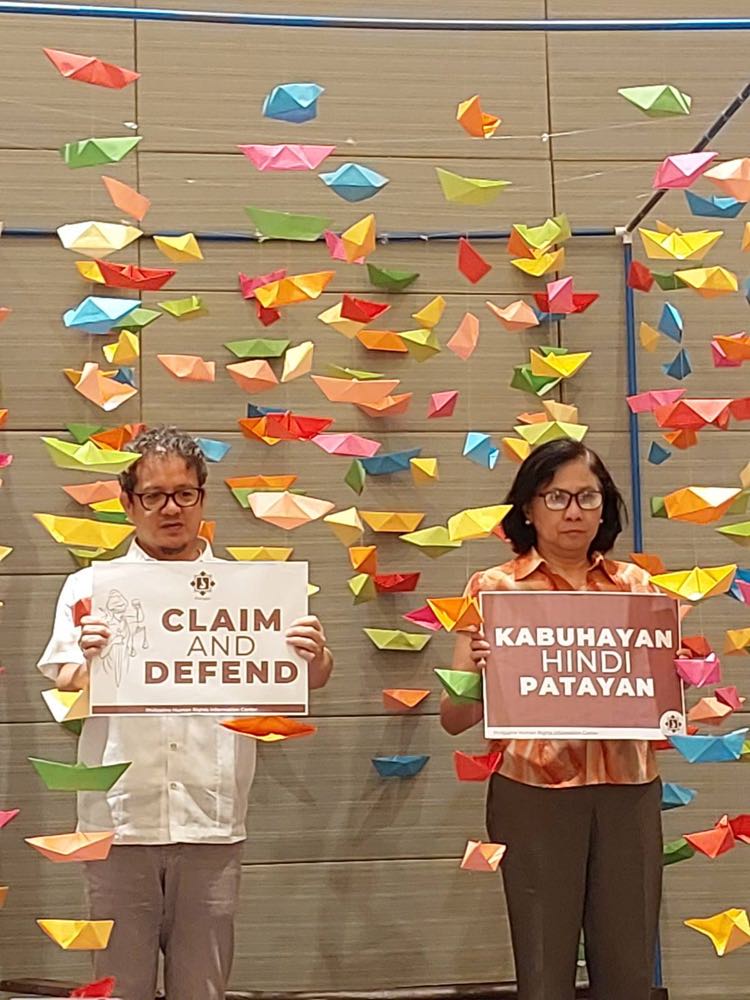
Marcos Jr. Receives Failing Marks on Human Rights in First Year as President
PAHRA, PhilRights decry worsening human rights crisis enabled by Marcos Jr.’s adoption of Duterte’s repressive playbook

As Ferdinand “Bongbong” Marcos Jr. prepares for his second State of the Nation Address (SONA), human rights groups condemned the administration’s track record on human rights which has been characterized by a wave of repression and violence, reminiscent of his father’s and his predecessor’s regime.
Earlier this week, the International Criminal Court (ICC) dismissed the Philippine government’s appeal to halt the investigation into Duterte’s alleged crimes against humanity. The Philippine Alliance of Human Rights Advocates (PAHRA) and the Philippine Human Rights Information Center (PhilRights) welcomed this decision, highlighting Marcos Jr.’s refusal to pursue justice for the victims and their families.
“The government’s continuous attempt to block the investigation and eventual prosecution of former President Duterte are signs of desperation. Duterte and his cohorts must be prosecuted. The recent ICC decision reflects the international community’s commitment to ensuring accountability and justice for human rights violations. The significance and outcomes of the ICC trial against President Duterte will depend on the legal proceedings and the obvious proof that mass slaughter indeed happened during his administration,” Rommel Yamzon, secretary-general of PAHRA said.
A Continuing Human Rights Crisis

The groups strongly condemned the escalating number of State-sponsored attacks targeting human rights defenders and activists throughout the country during the first year of Marcos Jr.’s presidency. This culture of impunity, which has persisted from the previous administration, continues to pose a significant threat to human rights of Filipinos.
According to PAHRA, numerous cases of threats, harassment, and fabricated charges against human rights defenders, often involving illegal arrest and arbitrary detention, or worse, summary executions, have been recorded. Victims are red-tagged or falsely accused of terrorist financing, supporting the communist insurgency, or illegal possession of weapons, of which the latter are often planted during raids by security forces.
PAHRA also pointed out that the lack of judicial independence and shrinking civic space do not just affect activists, but also lawyers, trade unionists, indigenous peoples, and others who speak up against the government. Human rights violations and impunity persist under the present government, according to Yamzon. Marcos Jr. is merely furthering the repressive playbook of his predecessors in addressing these concerns.
PhilRights for its part has documented hundreds of cases of human rights violations in the context of the so-called drug war, where thousands of individuals have been killed or disappeared.
In its latest report, covering six years of cases documented from eight hotspots of Oplan Tokhang operations, PhilRights asserts that Duterte’s so-called war on drugs has precipitated a full-blown human rights crisis that furthered a climate of impunity, injustice, and fear. This crisis is still ongoing, said Prof. Nymia Pimentel-Simbulan, PhilRights executive director.
“The first year of ‘Bongbong’ Marcos’ administration confirmed what many families of victims feared: that the ‘war on drugs’ would continue and that the justice-seeking efforts of families left behind would be thwarted,” said Simbulan.
Turning the Tide
“Marcos Jr.’s first year in office has been a disaster for democracy and human rights, with civilians bearing the brunt of living under an increasingly repressive regime,” said Simbulan.“The government has failed to address the country’s most critical issues, and Marcos Jr.’s leadership has only contributed to worsening human rights conditions across sectors.”
For Yamzon, a rights-based approach in governance and development is crucial. “A framework directed towards promoting and protecting human rights, based on international human rights norms and standards–that is the essence of the human rights-based approach.” This means “placing human rights and corresponding State obligations at the heart of policy. A tool to empower the most vulnerable people to participate in decision-making processes and hold duty-bearers accountable,” added Yamzon.
Still, human rights groups remain skeptical of the government’s sincerity in fulfilling its human rights obligations. Instead, both PAHRA and PhilRights are highlighting the strengthening of resolve of those most affected by this human rights crisis. “More and more victims’ families are joining hands and taking on the cause of justice. Their stories may be of loss and grief, but there is also an unfolding story of empowerment, tenacity, and a profound reclaiming of dignity,” said Simbulan.
###
About PhilRights
PhilRights is a non-stock, non-profit organization duly registered with the Securities and Exchange Commission. Established in 1991 as the research and information center of the Philippine Alliance of Human Rights Advocates (PAHRA), PhilRights is also an associated NGO of the United Nations Department of Public Information (UN DPI) and carry a special consultative status with the United Nations Economic and Social Council (UN ECOSOC).
PhilRights envisions a just, democratic, peaceful and prosperous Philippines founded on a culture of human rights and gender equity. Our work is focused on ushering in a society where each individual is able to fully realize their potential as a human person, participates effectively in the economic, political and cultural life, and shares equitably in the benefits of economic progress.
Our institutional programs are Human Rights research, education, and information. For more information, please visit www.philrights.org.
Facebook: @HumanRightsPhilippines | Twitter and Instagram: @PhilRights | Youtube: /PhilRights
About PAHRA
The Philippine Alliance of Human Rights Advocates (PAHRA) was established as an alliance of individuals, institutions and organizations committed to the promotion, protection and realization of human rights in the Philippines. The establishment of PAHRA was a consolidation of the human rights movement in the country and an acknowledgement of the important role played by human rights organizations in the anti-dictatorship struggle. It was a recognition of the need for a formal venue for cooperation and coordination among human rights groups in the country. Since its founding in 1986, PAHRA has consistently been in the forefront of the struggle for human rights. Today, it has established itself not only as one of the major human rights formations but as one of the leading voices in human rights advocacy in the Philippines.
Facebook: @PhilippineHumanRights.org | Twitter and Instagram: @PAHRAcampaigns
For more information:
Eiroll Manalo
Information Officer
0917 505 4701
emanalo@philrights.org
Christian Gultia
Communications Officer
0906 359 9353
pahra.communications@gmail.com

Submit your contribution online through HRonlinePH@gmail.com
Include your full name, e-mail address, and contact number.
All submissions are republished and redistributed in the same way that it was originally published online and sent to us. We may edit the submission in a way that does not alter or change the original material.
Human Rights Online Philippines does not hold copyright over these materials. Author/s and original source/s of information are retained including the URL contained within the tagline and byline of the articles, news information, photos, etc.

![[Press Release] Women and Child Rights Advocate Sally Ujano Acquitted of Rebellion; Freed After Court Appeals Ruling | Free Sally Ujano Group](https://hronlineph.com/wp-content/uploads/2026/03/fb_img_1774597247993.jpg?w=1024)
![[Video] Anong Talak ng Woke na Taumbayan?](https://hronlineph.com/wp-content/uploads/2026/03/fb_img_1774329031398.jpg?w=1024)
![[Statement] TDC Statement on the three grading period](https://hronlineph.com/wp-content/uploads/2026/03/fb_img_1774326816689.jpg?w=1024)
![[Statement] Reveal true solutions to the country’s water problem: More than conservation, water privatization must end | PMCJ](https://hronlineph.com/wp-content/uploads/2026/03/1004.jpg?w=1024)
 Human Rights Online Philippines
Leave a comment