
Philippines underscore need to Address Climate Change as well as Sex Trafficking at UN
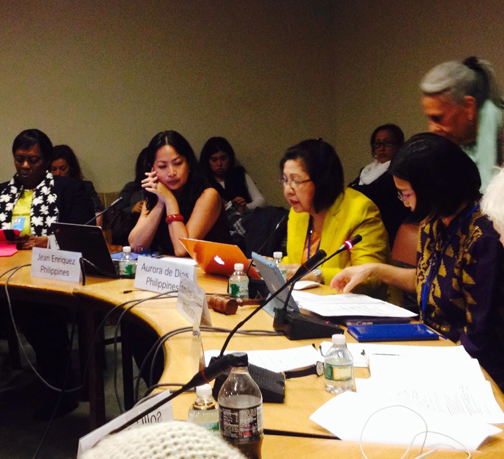
New York — Major stumbling blocks in the attainment of Millenium Development Goals (MDG) are climate change and the trafficking in women and children. This was the focus of a jampacked Side Event organized by the Philippine Permanent Mission in New York today, March 12, in cooperation with the Philippines Commission on Women (PCW). In time for the 58th UN Commission on the Status of Women Meeting, the Side Event included speakers from the Coalition Against Trafficking in Women (CATW) in Asia and Latin America, as well as from the Women’s Front (Kvinnefronten) of Norway.
“While climate change affects the entire world, countries in the global South are disproportionately victimized. As in the past, another saddening result of recent disasters in the Philippines is the reported increase in different forms of violence against women, including sex trafficking,” according to Jean Enriquez, Executive Director of CATW-Asia Pacific.
This discussion of climate change as part of the context of trafficking is particularly relevant as the UN conference on climate change is also going on right now in Bonn, Germany. “This is relevant because trafficked persons, especially sexually trafficked, ones mostly come from the devastated rural areas, added Enriquez. “They went with recruiters because they have lost their sources of livelihood. It has to be said that the devastated areas were also historically the biggest source of trafficked women and girls in the country as they rank relatively low in human development indices. Poverty, lack of education, lack of job, displacement of farming communities and indigenous ones in Mindanao all form parts of the conterxt of trafficking.”
Trafficking in women, in particular, are directed towards the urban areas as well as countries in the North. However, policies to address trafficking are not harmonized around the world. In many South countries, some laws continue to criminalize victims of trafficking and sexual exploitation. On the other hand, many countries in the North legalized the sex industry which receives many trafficked women, thus tolerating the perpetration of abuse against women.
Aurora De Dios, Philippine Representative to the ASEAN Commission for the Promotion and Protection of the Rights of Women and Children (ACWC) emphasized the need to curb the demand as the Philippines figure in the top ten of producers of child pornography. “Southeast Asia is both sending and receiving region for trafficked women and girls,” De Dios said. She asserted that the Nordic Model of punishing the buyers has to be legislated in countries in Southeast Asia in envisioning an alternative region.
Agnete Stroem, International Coordinator of Kvinnefronten, which was at the forefront of the decade-long struggle to pass the law punishing prostitution buyers cited the success of the model, “During the ten years implementation of the lawi n Sweden, a decreasing number of men over 18 years of age have purchased sexual services: from 13,6 % in 1996 to 7,8 % in 2008.” In Norway, 334 buyers were arrested, charged and fined in 2009, and 259 buyers were arrested, charged and fined in 2010.
Meanwhile, in the Netherlands and Germany, which legalized buying and pimping, findings show that neither have prostituted women got better conditions in prostitution, nor have more women been able to leave prostitution.
Teresa Ulloa of Mexico reinforced the the assertion that trafficking is exacerbated by disasters, as shown in Haiti. Ulloa presented strategies modeled after CATW-AP projects in the Philippines, to counter the demand side of trafficking, which includes educating young men on sexuality and gender issues.
“If we are to address trafficking therefore, legislation punishing not only the business but also the buyers who dictate the existence of the industry, is imperative,” according to Enriquez. “We also have to address the root causes of poverty, landlessness, joblessness, lack of access to public services that are now being privatizef sucgh as health and education. We have to address the climate crisis, transform our energy systems. Include violence against women and trafficking in discussing development goals. Address the fundamentals in to address underdevelopment. The fundamentals of inequalities — across regions — on consumption patterns, on asset distribution, on jobs and wages, and on the commodification of women’s bodies by patriarchal consciousness and practice.”
Overwhelming support fort the Nordic model was expressed in the open forum especially by participants from Canada, and countries in Africa. The panel was moderated by Executive Director Emmeline Verzosa of PCW.
All submissions are republished and redistributed in the same way that it was originally published online and sent to us. We may edit submission in a way that does not alter or change the original material.
Human Rights Online Philippines does not hold copyright over these materials. Author/s and original source/s of information are retained including the URL contained within the tagline and byline of the articles, news information, photos etc.

![[Statement] Statement of Condemnation to Quezon City 4th District Representative Bong Suntay on his Sexist and Objectifying Remarks | Miriam College – WAGI](https://hronlineph.com/wp-content/uploads/2026/03/fb_img_1772616021222.jpg?w=1024)
![[In the news] Pangasinan town nuke plan faces backlash | INQUIRER.net](https://hronlineph.com/wp-content/uploads/2026/02/screenshot-2026-02-09-143816.png?w=1024)
![[From the web] CHR backs stiffer penalties for hospital detention, urges focus on institutional accountability](https://hronlineph.com/wp-content/uploads/2026/02/627076470_1309237347897513_1019273190179875576_n.jpg?w=1024)
![[Press Release] PAHRA raises alarm over proposed social media registration, flags risks to free expression](https://hronlineph.com/wp-content/uploads/2026/02/fb_img_1770262130079.jpg?w=1024)
 Human Rights Online Philippines
Leave a comment