
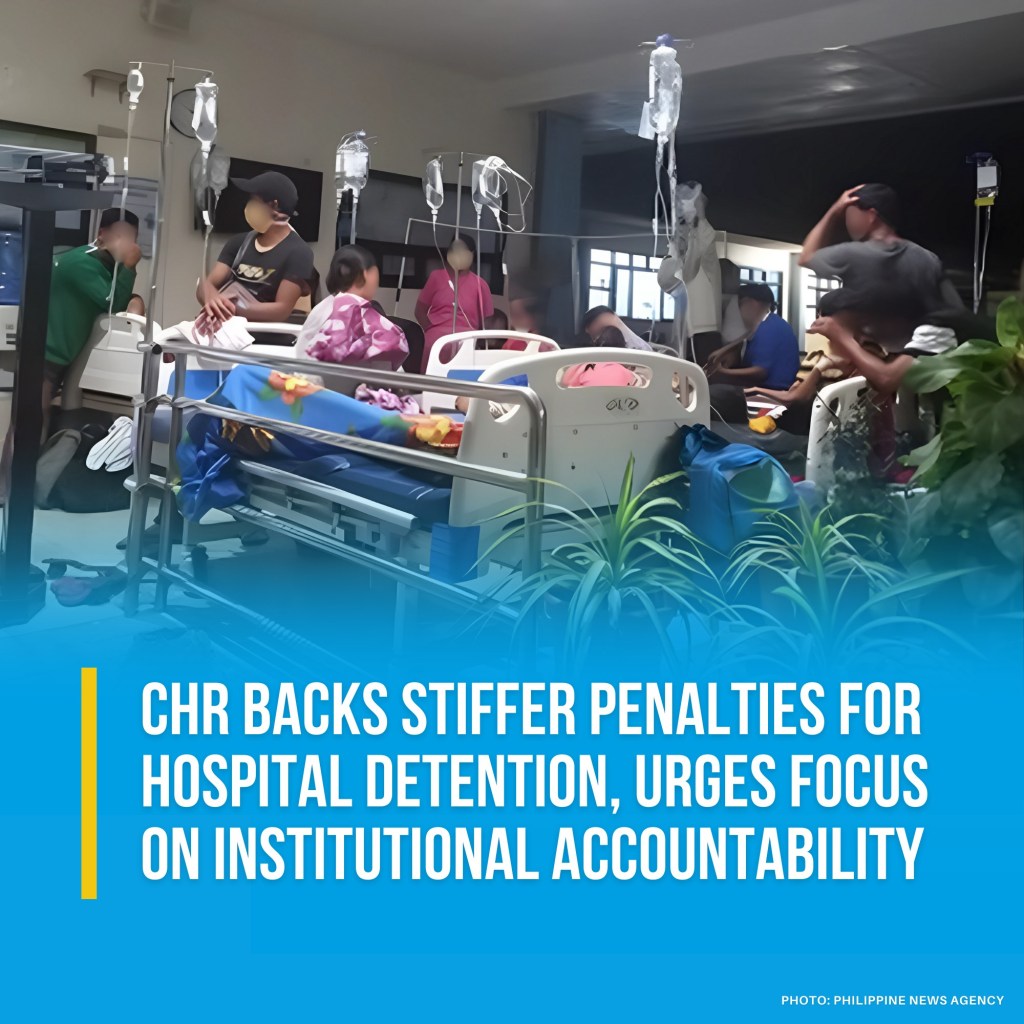
The Commission on Human Rights (CHR) expresses full support for the proposed amendments to Republic Act No. (RA) 9439, or the Anti-Hospital Detention Law, and strongly urges Congress to ensure that accountability is directed at hospital management and institutional policies that enable detention, not employees who lack authority to release patients.
In its position paper submitted to the Senate Committee on Health and Demography, the CHR underscores the need for “proportional and differentiated accountability,” emphasizing that responsibility for hospital detention primarily rests with those who formulate and enforce hospital policies, rather than with personnel who merely implement them. This reflects the human rights principle that those in authority bear responsibility for institutional practices that lead to violations.
Accordingly, the Commission recommends refining the penal provisions in Section 3 of the law to impose liability only on those who willfully and knowingly commit violations, while expressly protecting employees who act in good faith or without the authority to discharge patients or release cadavers. The CHR further proposes that hospitals, as juridical entities, be held administratively accountable for institutional policies or practices that result in hospital detention, ensuring that sanctions reach the level where decisions are actually made.
In addition to clarifying liability, the CHR also calls for a graduated system of administrative sanctions, such as suspension, mandatory compliance audits, or probationary monitoring, before resorting to license revocation, to safeguard fairness and due process while still deterring violations.
Moreover, the Commission urges the inclusion of explicit provisions guaranteeing victims access to separate civil and administrative remedies for damages, ensuring full redress for patients and families alongside penal sanctions.
These recommendations are grounded in the 1987 Constitution, specifically Article II, Section 11, which values the dignity of every human person, and Article XIII, Section 11, which mandates an integrated and comprehensive approach to health development.
They likewise affirm the Philippines’ obligations under the Universal Declaration of Human Rights and the International Covenant on Economic, Social, and Cultural Rights to uphold the rights to liberty, non-discrimination, and the highest attainable standard of physical and mental health.
The CHR emphasizes that strengthening RA 9439, enacted in 2007, is necessary to address persistent gaps in its implementation, as hospital detention continues to disproportionately affect indigent patients, penalizing poverty by depriving patients and even families of liberty at moments of illness, grief, and vulnerability.
Consistent with its mandate, the Commission remains committed to working with Congress to refine the measure and advance legislation that places human rights, fairness, and dignity at the center of national health policies.
Read the full position paper here:
https://chr.gov.ph/chr-resource/position-paper-on-anti-hospital-detention/?fbclid=IwY2xjawP2WG5leHRuA2FlbQIxMABicmlkETFFVFl2NE9TNHRuSnhTYzZuc3J0YwZhcHBfaWQQMjIyMDM5MTc4ODIwMDg5MgABHnUIp0nBNz9uMElh-q06SOpmCDiLG2iBIU5j7Qm8BnFAUpSd4kQz-y0sBCLd_aem_bDiHFTpWbKS6m7edc7XIMA


![[Press Release] Women and Child Rights Advocate Sally Ujano Acquitted of Rebellion; Freed After Court Appeals Ruling | Free Sally Ujano Group](https://hronlineph.com/wp-content/uploads/2026/03/fb_img_1774597247993.jpg?w=1024)
![[Video] Anong Talak ng Woke na Taumbayan?](https://hronlineph.com/wp-content/uploads/2026/03/fb_img_1774329031398.jpg?w=1024)
![[Statement] TDC Statement on the three grading period](https://hronlineph.com/wp-content/uploads/2026/03/fb_img_1774326816689.jpg?w=1024)
![[Statement] Reveal true solutions to the country’s water problem: More than conservation, water privatization must end | PMCJ](https://hronlineph.com/wp-content/uploads/2026/03/1004.jpg?w=1024)
 Human Rights Online Philippines
Leave a comment