
The Teachers’ Dignity Coalition (TDC) recognizes with appreciation the provision of the ₱7,000 annual medical allowance for teachers—a first in government policy that acknowledges the health and well-being needs of government employees and public school teachers. This is a welcome development and a long-overdue investment in employees’ welfare.
However, reports from the field reveal inconsistencies, lack of clarity, and varied practices in the distribution and utilization of this allowance. Without proper guidance and consistent execution, this program risks causing confusion, inequity and dismay among teachers.
In this regard, we respectfully submit this position paper to bring to the attention of the Department of Education (DepEd) Central Office, the Department of Budget and Management (DBM), and Malacañang the current situation, urgent questions that require clarification, and recommendations for more effective and teacher-centered implementation in the succeeding years.
Situation in the Field
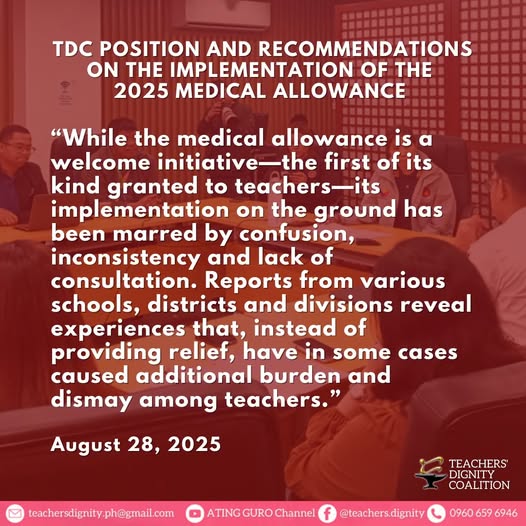
While the medical allowance is a welcome initiative—the first of its kind granted to teachers—its implementation on the ground has been marred by confusion, inconsistency and lack of consultation. Reports from various schools, districts and divisions reveal experiences that, instead of providing relief, have in some cases caused additional burden and dismay among teachers.
The following points highlight the recurring issues encountered in the field:
- In some cases, individual teachers were allowed to choose their own HMO under Option 2 (individual availment), but were later compelled to join the group availment scheme of their SDO, district or school.
• Teachers who initially chose the individual option were instructed to change to group availment.
• In certain schools, teachers who already received the allowance in cash were told not to use it, since the entire amount had to be remitted to the HMO chosen by the school.
• In one district, the ₱7,000 cash credited to teachers’ accounts was taken back and collected by the PSDS for district-wide group availment.
• In at least one SDO, teachers had no choice but to take Option 2, with all funds turned over to the SDO for a collective HMO arrangement. - No proper explanation was provided by some SDOs on the details of the Medical Allowance or the terms and conditions of agreements entered into. Many teachers said they were neither informed nor consulted about which HMO was chosen for them.
- Teachers were excluded from the planning and decision-making process, leaving them uncertain about how the scheme was implemented.
- Disbursement requirements varied, some mandated HMO purchase within two weeks, others within one month, still others within two months.
- In some cases, teachers were compelled to maximize the ₱7,000 solely for HMO coverage. If the chosen HMO cost less, the balance had to be refunded.
- A teacher reported she intended to use the allowance for diabetes treatment but was warned that HMO purchase must be reported within two weeks.
- Some reports indicate that teachers who did not respond to the survey form will be denied the ₱7,000 Medical Allowance.
- Some teachers opted to waive the ₱7,000 medical allowance altogether due to confusion.
- Fortunately, in rare cases, reimbursement of medical expenses incurred in cash was allowed by the SDO.
Questions for Urgent Clarification
Given the varying interpretations and inconsistent practices observed in the field, several issues remain unresolved. These matters create confusion among teachers, risk inequitable implementation, and may even result in unintentional non-compliance.
To ensure fairness and uniformity, we respectfully seek immediate clarification on the following points:
- What is the official deadline for the disbursement of the ₱7,000 medical allowance upon receipt? Clear guidance is necessary to prevent undue pressure or arbitrary timelines imposed by SDOs.
- While the guidelines state that the Medical Allowance covers employees with at least six months of service, what is the precise cut-off date for eligibility? Specifically, are teachers who resigned after June 30 and those hired before July 1, 2025, still entitled to receive it?
- Are teachers who did not submit or answer the survey form still eligible to receive the ₱7,000 Medical Allowance? If so, what would be the default scheme—through group availment, individual availment, or direct cash release?
- With only four months left in the year, are HMOs still required to strictly comply with all five considerations under DO No. 16, s. 2025, even if teachers have already paid for and completed their annual physical examinations?
- If an HMO purchased in 2025 is valid for one year and extends into August 2026, can a teacher choose coverage that only applies to the remaining months of 2025?
- If the SDO arranges for an HMO that similarly overlaps into 2026, can coverage be limited to the last four months of 2025 instead of a full-year plan?
- Can teachers submit official receipts for medical expenses already incurred in 2025 as a valid alternative to mandatory HMO purchase, ensuring that no teacher is penalized for addressing their health needs outside the HMO arrangement?
Recommendations for Future Implementation
The introduction of the medical allowance is a significant and positive step toward supporting teachers health and well-being and we commend President Ferdinand R. Marcos, Jr. for his initiative in providing this benefit. However, its effectiveness depends on clear, fair, and practical implementation. Without proper guidance and consistent execution, this benefit risks causing confusion and inequity, undermining its intended purpose.
The following recommendations are respectfully submitted for the consideration of the Department of Education, the Department of Budget and Management, and Malacañang, to ensure that the allowance truly serves teachers and employees needs:
- Provide clear guidelines and information materials. The DepEd, through SDOs or public platforms, should issue clear explanations—either through a written primer, infographics, or an instructional video—addressing FAQs on the Medical Allowance. This will ensure transparency and consistent implementation.
- Allow sufficient time and informed choice. Considering that the deadline for the release is on August 31, SDOs must provide proper orientation and complete information so teachers can make informed decisions based on their actual health needs and circumstances.
- Allow flexible use of the medical allowance. Teachers should be allowed to use the ₱7,000 for medical-related expenses, including compulsory medical examinations, maintenance medicines, other medical costs, or health services outside the HMO arrangement, as well as for other health-related needs for the remaining months of the year.
- Strengthen PhilHealth instead of restricting to HMOs. Rather than limiting teachers to HMOs and directing public funds to private businesses, the government should allocate government money to strengthen and maximize PhilHealth benefits, ideally offering better coverage than the current best HMO provider. This will allow teachers broader access to medical services without being restricted to a single provider.
- Release the Medical Allowance directly in cash. For future implementation, the allowance should be provided directly to teachers without restrictions on disbursement, allowing them to use it according to their health needs—such as for disease prevention, multivitamins, maintenance medicines, healthy lifestyle, or nutritious food. This cash benefit should complement, not replace, the strengthened and expanded PhilHealth coverage being implemented alongside it.
The Medical Allowance is a vital support for teachers health and well-being, but its inconsistent and unclear implementation has raised serious concerns. During the August 19, 2025 dialogue at the DBM Central Office with Secretary Amenah Pangandaman and DepEd Undersecretary Wilfredo Cabral, in the presence of other DepEd and DBM officials, several important nuances were discussed, including the liberal treatment of HMO purchase and the option to submit proof of actual medical expenses as a valid alternative to HMO enrollment. These practices, if clarified and consistently applied, could help ensure that teachers fully benefit from the program.
While we acknowledge the DepEd Central Offices issuances—an Order and three Memoranda—intended to refine policy and provide flexibility, we respectfully urge the honorable office to issue immediate clarifications and consider further policy adjustments to address these practical considerations.
For this initiative to succeed, teachers must be actively involved at every stage. Their voices, through faculty clubs and organizations at all levels—school, district, division, regional and national—should be heard, consulted, and represented in planning and monitoring.
We commend the offices of the Secretaries of DBM and DepEd for their continuing engagement with teachers organizations, particularly the Teachers Dignity Coalition (TDC). We hope that this collaboration will lead to a transparent, inclusive, and responsive implementation of the medical allowance in the future.
Reference:
Benjo Basas, National Chair
09273356375


![[Press Release] Women and Child Rights Advocate Sally Ujano Acquitted of Rebellion; Freed After Court Appeals Ruling | Free Sally Ujano Group](https://hronlineph.com/wp-content/uploads/2026/03/fb_img_1774597247993.jpg?w=1024)
![[Video] Anong Talak ng Woke na Taumbayan?](https://hronlineph.com/wp-content/uploads/2026/03/fb_img_1774329031398.jpg?w=1024)
![[Statement] TDC Statement on the three grading period](https://hronlineph.com/wp-content/uploads/2026/03/fb_img_1774326816689.jpg?w=1024)
![[Statement] Reveal true solutions to the country’s water problem: More than conservation, water privatization must end | PMCJ](https://hronlineph.com/wp-content/uploads/2026/03/1004.jpg?w=1024)
 Human Rights Online Philippines
Leave a comment