
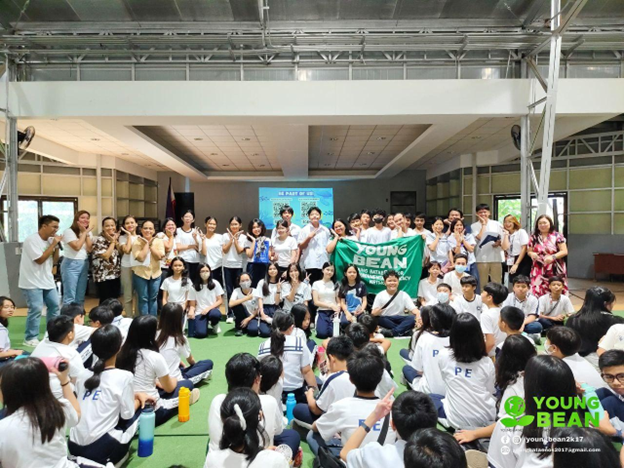
The Young Bataeños for Environmental Advocacy Network (Young BEAN) https://www.facebook.com/youngbean2k17 wants to emphasize that protecting the environment should be a shared responsibility. They are starting with the youth.
By Human Rights Online Philippines (HRonlinePH)
Defending human rights is dangerous work. But for those protecting the environment, the risks run even deeper, as they face not only the power of the state but also the vast resources and influence of private corporations determined to silence dissent.
This is the everyday reality that the Young Bataeños for Environmental Advocacy Network (Young BEAN) lives and breathes. Since its founding in 2017, the youth-led organization has been steadfast in promoting environmental protection and preservation, while championing climate justice and pushing for meaningful social transformation.
Protecting the environment should be a shared responsibility. Any harm done to nature, after all, will eventually affect us all. For the members of Young BEAN, that impact is even more immediate as they witness the damage unfolding in their own communities.
Nestled between two mountain ridges in the southwestern part of Central Luzon, Bataan has long depended on its natural resources. Its more than 100 rivers support both farmers and fishermen, while its 177-kilometer coastline connects communities to the richness of the sea.
Losing these to projects that harm the environment could mean lost livelihoods, vanishing traditions, and food insecurity for entire families. It could also mean the slow death of ecosystems that generations have nurtured and depended on, all for the sake of profit.
“Sumama po ako dito sa organization na ito kasi malaki po yung inspiration po na binibigay po sa akin na ipaglaban ang mga kabataan, kasi nagtatanggol po kami ng mga kapwa po namin kabataan sa mga malalaki mga projects na nakakasira po sa environment and sa future po namin mga kabataan,” Enrique Beren, Young BEAN secretary-general and spokesperson, said.
(I joined this organization because it gives me so much inspiration to fight for the youth. Because we’re standing up for our fellow youth against destructive projects that are harming the environment and threatening our future as young people.)
Coal-fired power plants pose a serious threat not just to the environment, but also to the daily lives of residents. Beren recalled how young people would complain that the constant noise from the plants made it difficult to concentrate on their studies. There were even reports of children falling ill allegedly due to emissions and other pollutants coming from the facilities.
But as much as they want to fight, they are painfully aware of the dangers that come with challenging powerful business owners, especially at their young age. Young BEAN has over 200 members, nearly 90% of whom are between 15 and 28 years old, many still in high school or university. Yet, their youth has not spared them from being red-tagged or maliciously labeled as communist rebels.
Young BEAN chairperson Jochelle Magracia recounted a time they stood firm against an online narrative that favored quarrying activities in Mt. San Miguel, in Mariveles, Bataan. Aware of the harm these operations were inflicting on nearby communities, they worked relentlessly to counter misinformation. They shared factual and impactful posts that shed light on the residents’ suffering.
“Pero kahit na nagpaliwanag kami kung bakit kami tumututol, pinakalat pa rin iyong aming mga Facebook profiles, comments namin, at pinost ng ilan sa kanila, tinawag pa kaming mga terorista,” she said.
(But even though we explained why we opposed it, they still spread our Facebook profiles and comments. Some even posted about us and called us terrorists.)
Then there’s the challenge of organizing among the youth. Since most of Young BEAN’s target members are students and community youth, it makes sense that their programs and events are centered in communities, schools and universities. But not all institutions are welcoming. Some administrations refuse to recognize the organization or worse, actively find ways to block them from carrying out their activities.
Tapping the network for advocacy
These challenges persist but Young BEAN refuses to be stopped in their tracks. Fighting for the environment is a calling that demands courage and they meet that demand head-on. They do not take harassment sitting down.
Chairperson Jochelle Magracia shared that Young BEAN regularly engages in dialogues with stakeholders to find ways forward. They’ve planned to request meetings with school administrations, and even with the Commission on Human Rights, to address red-tagging incidents happening within campuses.
But their response goes beyond resistance. Young BEAN is also focused on empowering their members. Not only to become stronger environmental advocates, but to protect themselves as individuals. They’re now preparing to launch security training sessions for youth communities aimed at preventing any threats or harm as they carry out their work.
For this, the organization aims to tap their network of other civil society groups that could help them achieve their goals. They plan on modelling it after the assistance provided to them by the Human Rights Online Philippines (HRonlinePH) through its Gen Z for HR (Human Rights) and Social and Behavior Change Campaigns, which aims to foster critical voices among the youth in the country.
Through this project, HRonlinePH supported Young BEAN in sharpening how they communicate their advocacies on social media where much of their target audience naturally spends time. After all, the Philippines had around 87 million social media users in 2024, according to digital marketing agency Spiralytics, and that number is only expected to keep growing in the years ahead.
“Since nandito po kami sa ground doing our work as a frontliners po ng pagtatanggol sa karapatang pantao, mahalaga na merong mga tao tulad po ng HRonlinePH at different organizations ang nakakakita ng halaga ng mga grassroots organizations like us,” Beren said.
(Since we’re here on the ground doing the work as frontliners in defending human rights, it’s important that there are groups like HRonlinePH, and other organizations who recognize the value of grassroots organizations like ours.)
Young BEAN now enjoys a strong social media following, balancing an educational presence with wit and charm This is an ideal mix in a digital space often ruled by short attention spans. A quick look on their Facebook will show posts that are personal in its approach on advocating for the environment.
In November 2024, for example, Young BEAN celebrated the Global Day of Action for Climate Justice by doing an online campaign featuring easy-to-understand infographics that highlighted the urgent need for climate action as four super typhoons threatened the Philippines. They linked these local vulnerabilities to the broader global climate discourse at COP29 in Baku, while amplifying the voices of frontline communities.
Young BEAN not only raises awareness about environmental issues through their online campaigns, but also fosters a sense of responsibility and activism among the youth. The messages resonate well and encourage collective efforts towards a more sustainable future.
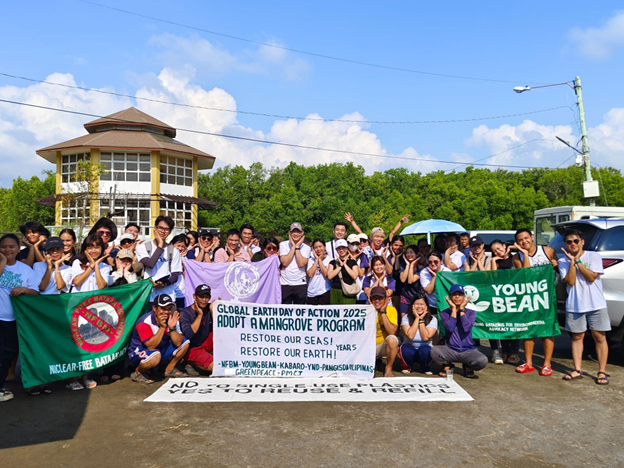
This was seen in how the organization used social media to spotlight their grassroots efforts and inspire others to take action. On April 20, Easter Sunday, Young BEAN led a coastal clean-up and mangrove planting activity in Barangay Camachile, Orion, Bataan, uniting youth volunteers, local fisherfolk, and advocacy groups under the theme “Restore Our Seas, Restore Our Earth.”
The initiative is now in its fourth year and has aimed to plant over 250 mangrove seedlings as part of their ongoing commitment to environmental restoration. Young BEAN, through social media, not only celebrated community collaboration but also encouraged more young people to join the movement and take part in local climate action.

![[Press Release] Women and Child Rights Advocate Sally Ujano Acquitted of Rebellion; Freed After Court Appeals Ruling | Free Sally Ujano Group](https://hronlineph.com/wp-content/uploads/2026/03/fb_img_1774597247993.jpg?w=1024)
![[Video] Anong Talak ng Woke na Taumbayan?](https://hronlineph.com/wp-content/uploads/2026/03/fb_img_1774329031398.jpg?w=1024)
![[Statement] TDC Statement on the three grading period](https://hronlineph.com/wp-content/uploads/2026/03/fb_img_1774326816689.jpg?w=1024)
![[Statement] Reveal true solutions to the country’s water problem: More than conservation, water privatization must end | PMCJ](https://hronlineph.com/wp-content/uploads/2026/03/1004.jpg?w=1024)
 Human Rights Online Philippines
Leave a comment