
Labor NGO Ecumenical Institute for Labor Education and Research expresses concern over the bicameral conference committee report on the 2025 national budget. The report states that Philippine Health Insurance Corp. (PhilHealth) will receive zero subsidy for the following year. The lawmakers argued that PhilHealth must utilize its PhP 600 billion reserve funds to cover premiums and debt payments. Earlier this year, PhilHealth asked for a PhP 150 billion budget to cover premiums of its indirect contributors (e.g. indigent, senior citizens, persons with disability, 4Ps beneficiaries).
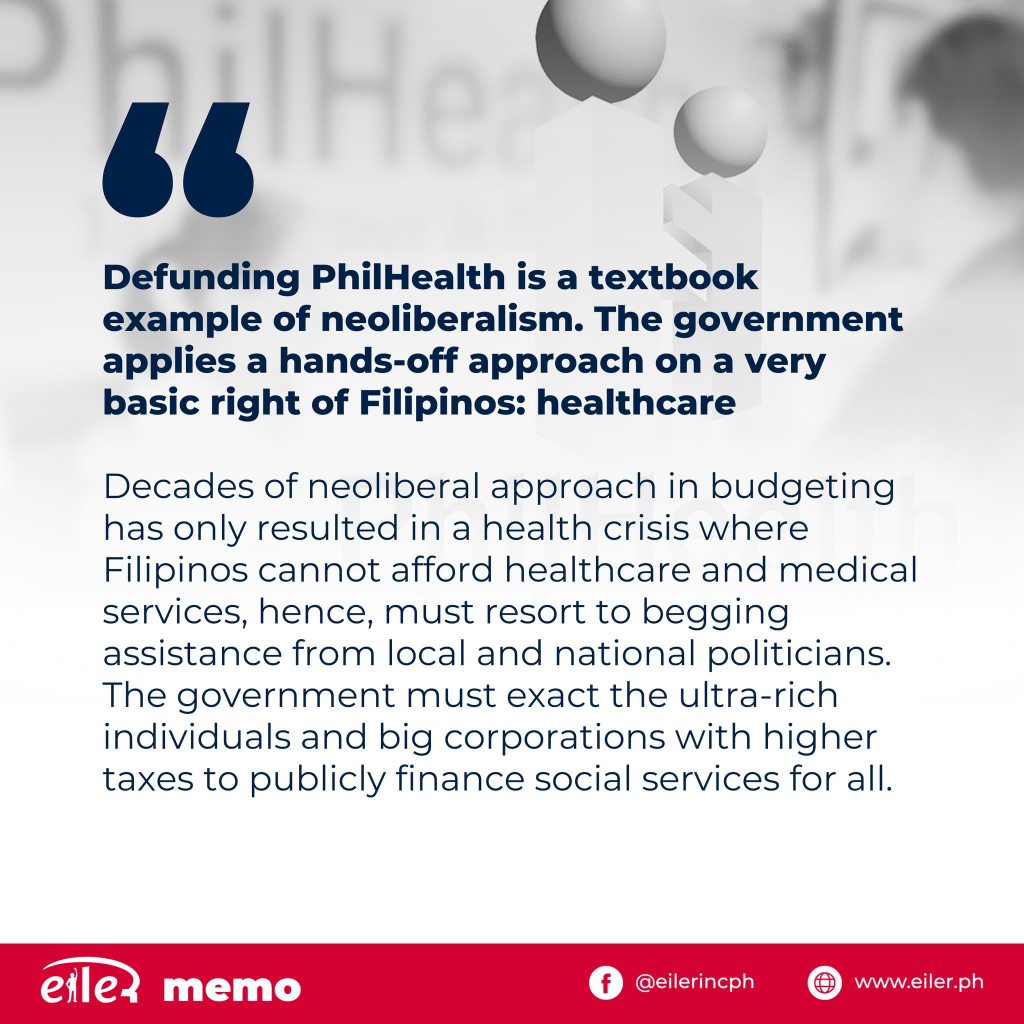
“Defunding PhilHealth is a textbook example of neoliberalism,” according to Gene Rodriguez, Officer in Charge of EILER. “The government applies a hands-off approach on a very basic right of Filipinos, that is, healthcare. Additionally, the budget allocations for the education and labor departments have also been cut,” Rodriguez added.
EILER noted that in contrast, the government will spend a big chunk of the budget to attract investments and ease doing business through an allocation of PhP 1.1 trillion to infrastructure projects. This allotment is even larger than the allocation for DepEd (PhP 737 billion) and Department of Health (PhP 277 billion) combined.
“Instead of defunding the national health insurance program and other social services, lawmakers should re-channel confidential and intelligence funds of civilian agencies/offices like the Office of the President and allocations for red-tagging agencies like NTF-ELCAC, AFP, and PNP,” Rodriguez said.
According to EILER, the public financing of social services and social protection should also be prioritized. Decades of neoliberal approach in budgeting has only resulted in a health crisis where Filipinos cannot afford healthcare and medical services, hence, must resort to begging assistance from local and national politicians. The government must exact the ultra-rich individuals and big corporations with higher taxes to publicly finance social services for all. In 2021 alone, the income of the richest 10% families is almost as large as the income of the poorest 50% families in the country.
Reference: Gene Rodriguez, +649452110720


![[Press Release] Women and Child Rights Advocate Sally Ujano Acquitted of Rebellion; Freed After Court Appeals Ruling | Free Sally Ujano Group](https://hronlineph.com/wp-content/uploads/2026/03/fb_img_1774597247993.jpg?w=1024)
![[Video] Anong Talak ng Woke na Taumbayan?](https://hronlineph.com/wp-content/uploads/2026/03/fb_img_1774329031398.jpg?w=1024)
![[Statement] TDC Statement on the three grading period](https://hronlineph.com/wp-content/uploads/2026/03/fb_img_1774326816689.jpg?w=1024)
![[Statement] Reveal true solutions to the country’s water problem: More than conservation, water privatization must end | PMCJ](https://hronlineph.com/wp-content/uploads/2026/03/1004.jpg?w=1024)
 Human Rights Online Philippines
Leave a comment