
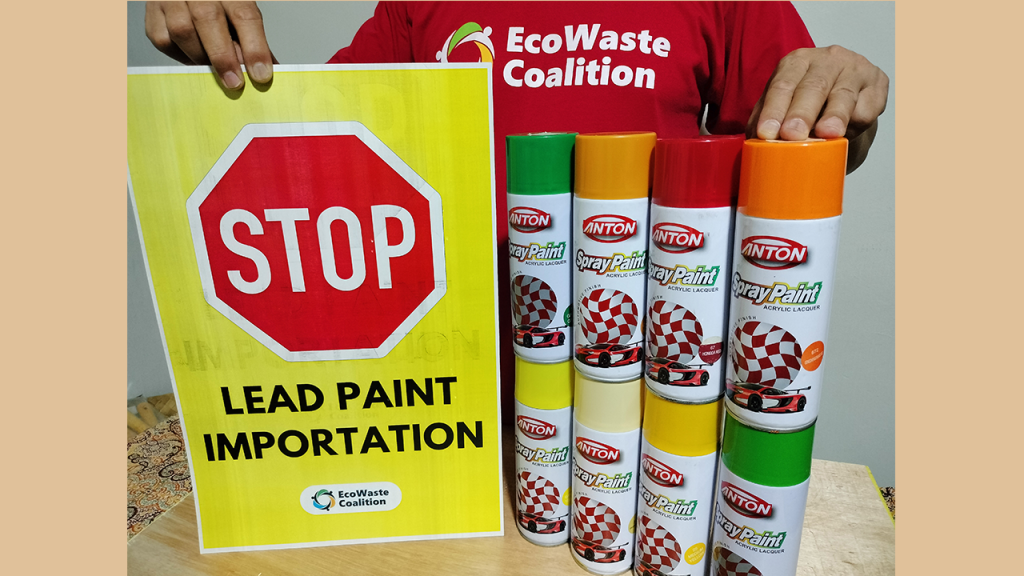
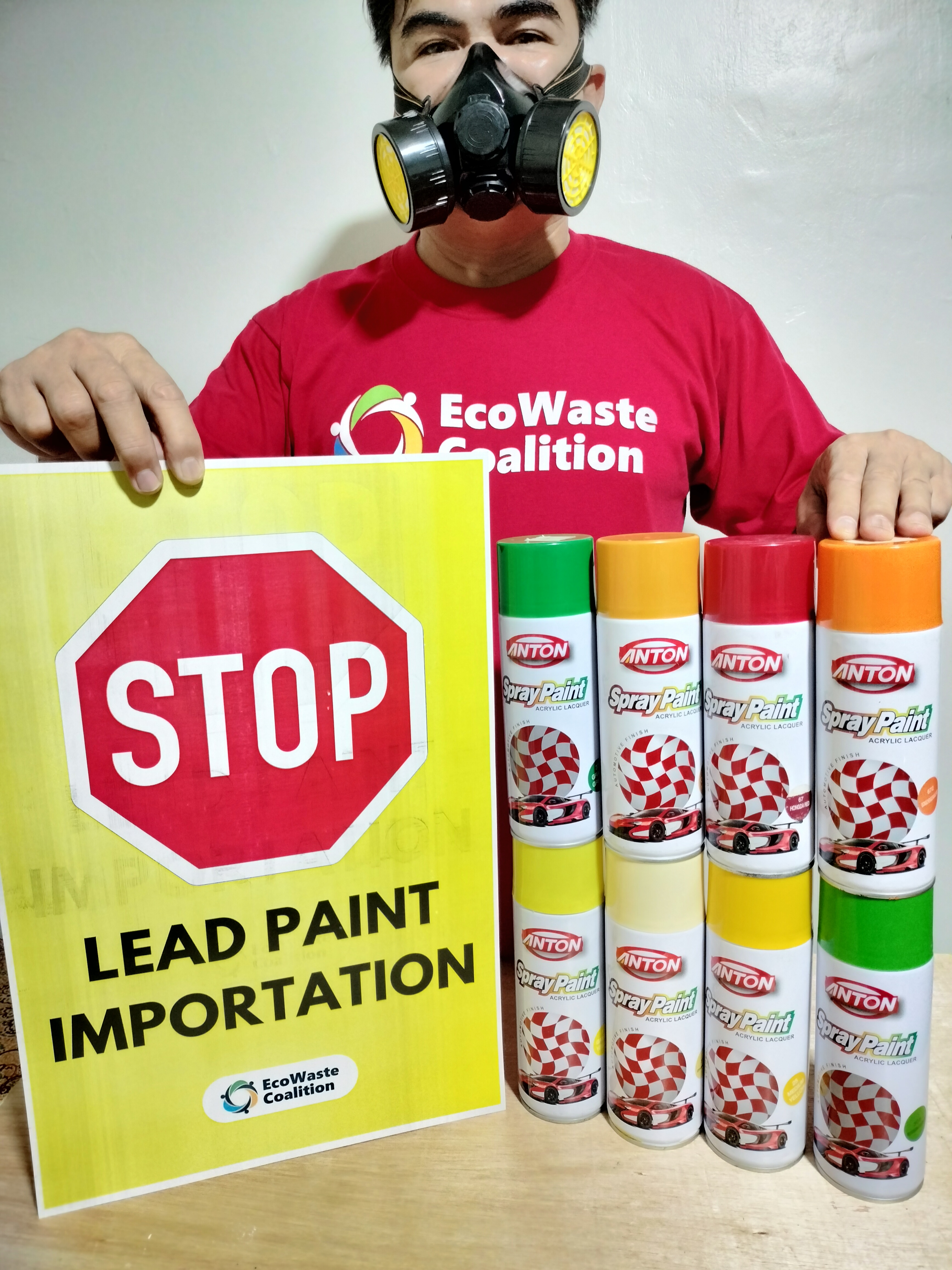
The toxics watchdog group EcoWaste Coalition advised consumers to steer clear of China-made Anton Spray Paint after finding three more variants laced with high levels of lead, a potent neurotoxin.
According to the chemical screening conducted by the group, the canary yellow, orange yellow and grain yellow variants of Anton Spray Paint contained 26,550 parts per million (ppm), 25,400 ppm and 3,330 ppm of lead, respectively.
The group ordered the canary yellow and grain yellow Anton Spray Paints for P100 each from an online seller, while it bought the orange yellow one for P60 from a retailer at 999 Shopping Mall in Manila.
The group previously sent five of the said paint to a private laboratory for lead content analysis, which found lead on the medium yellow, grass green, Gongcheng orange red, refrigerator green, and Honda red colors measured at 57,100 ppm, 53,400 ppm, 33,100 ppm, 31,400 ppm and 5,895 ppm, respectively.
To date, the EcoWaste Coalition had detected violative levels of lead on eight colors of Anton Spray Paint, which, according to the product label, can be used for coating household appliances, furniture and fixtures, equipment, and bicycles.
Department of Environment and Natural Resources (DENR) Administrative Order No. 2013-24, or the Chemical Control Order (CCO) for lead and lead compounds, established a maximum limit of 90 ppm for lead in all paints and provided for a phase-out period for leaded decorative paints from 2013-2016 and leaded-industrial paints from 2013-2019.
The proliferation of leaded paints in the local market has prompted the group to campaign for improved promotion, monitoring and enforcement of the country’s lead paint regulation, which won in 2021 the Future Policy Award (special category on lead in paint).
As most of the lead-containing paints being offered for sale are imported from abroad, China and Thailand in particular, the EcoWaste Coalition is pushing for stricter global rules to control the trade of lead chromates, the most common pigments used in lead paint, and the paint products containing them.
Together with IPEN and other environmental health groups, the EcoWaste Coalition is advocating for the listing of lead chromates as hazardous chemicals subject to the Rotterdam Convention’s Prior Informed Consent (PIC) Procedure. If listed, companies exporting lead chromates or paints containing them may not ship these commodities to a country that has not consented to receiving them.
Governments can use the PIC Procedure to restrict or prevent the entry of lead chromates and paints that contain them into their territories. Doing so will make it easier for the Philippines and other nations to enforce their lead paint regulations and this, in turn, will encourage other countries to promulgate lead paint controls, the groups said.
Reference:
https://chemical.emb.gov.ph/wp-content/uploads/2017/03/DAO-2013-24-CCO-Lead.pdf
https://ipen.org/site/listing-lead-chromates-under-rotterdam-convention
EcoWaste Coalition
78-A Masigla Extension, Barangay Central, 1100 Quezon City, Philippines
Phone: +632-82944807 E-Mail: info@ecowastecoalition.org
Website: http://ecowastecoalition.blogspot.com


![[Press Release] Women and Child Rights Advocate Sally Ujano Acquitted of Rebellion; Freed After Court Appeals Ruling | Free Sally Ujano Group](https://hronlineph.com/wp-content/uploads/2026/03/fb_img_1774597247993.jpg?w=1024)
![[Video] Anong Talak ng Woke na Taumbayan?](https://hronlineph.com/wp-content/uploads/2026/03/fb_img_1774329031398.jpg?w=1024)
![[Statement] TDC Statement on the three grading period](https://hronlineph.com/wp-content/uploads/2026/03/fb_img_1774326816689.jpg?w=1024)
![[Statement] Reveal true solutions to the country’s water problem: More than conservation, water privatization must end | PMCJ](https://hronlineph.com/wp-content/uploads/2026/03/1004.jpg?w=1024)
 Human Rights Online Philippines
Leave a comment