
Real Improvements Need Strong Action, Commitment to Reform
By Carlos H. Conde
Senior Researcher, Asia Division
Human Rights Watch
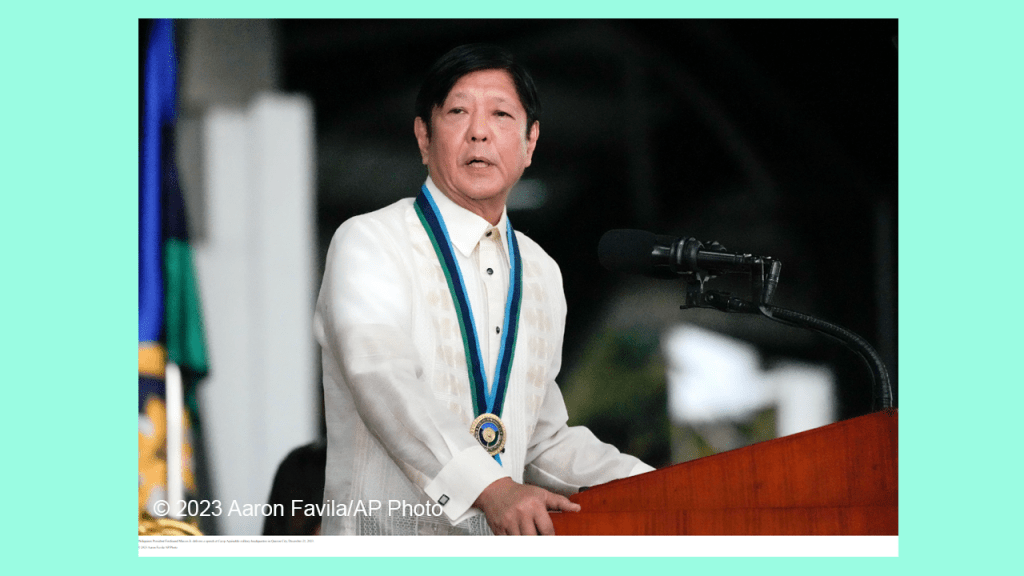
President Ferdinand Marcos Jr. has created a “super body” to promote human rights protection in the Philippines.
On paper, the Special Committee on Human Rights Coordination looks impressive, and its stated purpose is admirable. But as constructed, the body will have little authority to address the serious rights abuses facing the country.
At best, the special committee is a coordinating mechanism among its members: the Presidential Human Rights Committee, the Department of Justice, the Department of the Interior and Local Government, which oversees the Philippine National Police, and the Department of Foreign Affairs. None of these entities have distinguished themselves combatting rights violations, including thousands of extrajudicial killings in the “war on drugs” since 2016.
The administration said the special committee will replace the structures set up by the United Nations Joint Programme, a technical cooperation and capacity-building program run by the UN to institutionalize human rights reforms. However, the program proved unable to fulfill its mandate because of the COVID-19 pandemic and the Philippine government’s initial lack of engagement. The three-year program is set to expire in July after Manila and UN member countries decided not to extend it.
The Philippine government has sought to frustrate attempts by the UN Human Rights Council and now the International Criminal Court to investigate grave abuses committed in the “drug war.” This meant haphazard cooperation with the UN Joint Programme.
Excluded from the new special committee is the Commission on Human Rights (CHR), created as an independent body under the 1987 Philippine Constitution and mandated to investigate human rights violations. The CHR is in the best position to do what the “special committee” is tasked to do. If Marcos were serious about improving human rights protections and accountability for abuses, he would seek an expanded role for the CHR, including by ensuring they were part of the new special committee. He would also create a clear role for the involvement of nongovernmental human rights groups.
The human rights “super body” might impress some foreign observers, but what would impress people in the Philippines would be rescinding the “war on drugs,” ending the targeting of activists through often deadly “red-tagging,” and fairly prosecuting government officials implicated in serious rights violations. Another layer of questionable bureaucracy will do little to protect anyone’s rights in the Philippines.

![[Press Release] Women and Child Rights Advocate Sally Ujano Acquitted of Rebellion; Freed After Court Appeals Ruling | Free Sally Ujano Group](https://hronlineph.com/wp-content/uploads/2026/03/fb_img_1774597247993.jpg?w=1024)
![[Video] Anong Talak ng Woke na Taumbayan?](https://hronlineph.com/wp-content/uploads/2026/03/fb_img_1774329031398.jpg?w=1024)
![[Statement] TDC Statement on the three grading period](https://hronlineph.com/wp-content/uploads/2026/03/fb_img_1774326816689.jpg?w=1024)
![[Statement] Reveal true solutions to the country’s water problem: More than conservation, water privatization must end | PMCJ](https://hronlineph.com/wp-content/uploads/2026/03/1004.jpg?w=1024)
 Human Rights Online Philippines
Leave a comment