
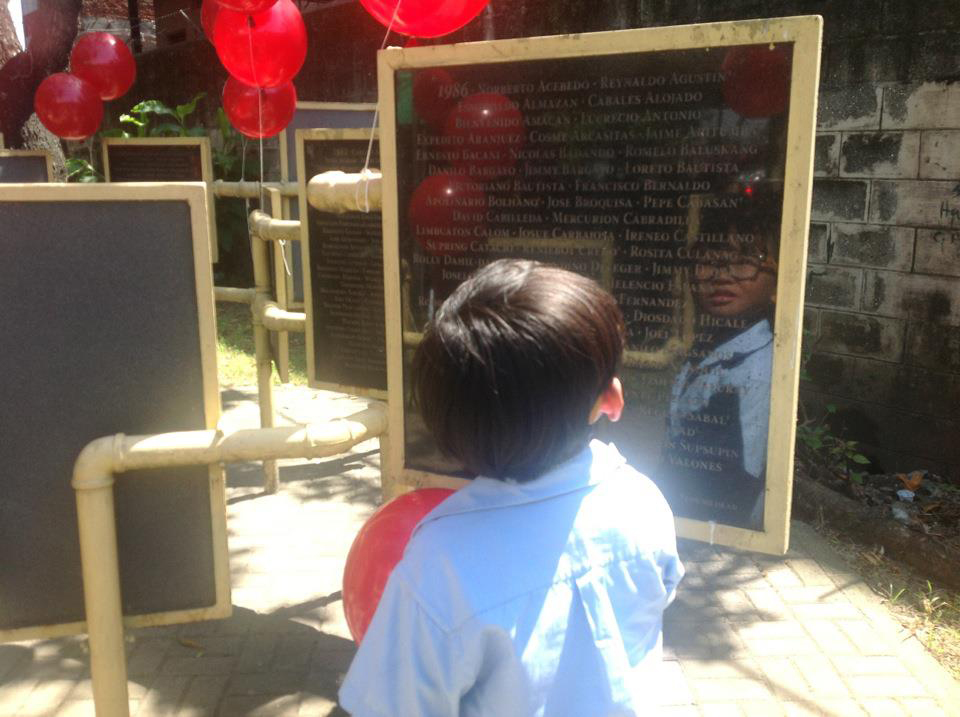
Honoring and celebrating the life, struggle and triumph of the desaparecidos and their families

 This time of the year, Filipino families pay tribute to their dearly departed with prayers and lighted candles. The case, however, is different with the families of the disappeared. Families of victims of enforced disappearance have to deal with their missing kin, whose whereabouts have been concealed for endless years. Enforced disappearance is a heinous offense perpetrated by state agents to maintain the status quo. Its roots in the Philippines can be traced back to the dark days of Martial Law, Ferdinand Marcos’ despotic rule, and has continued since then.
In a society that yearns for change and development, various individuals rise to stand up for peoples’ rights and defend the interests of the marginalized sectors. These agents of change are prey to the perpetrators of enforced disappearance. Clueless on the fate and whereabouts of their missing kin, the families, relatives and friends can only offer mass and prayers in honor of such martyrs.
In Metro Manila, relatives, human rights advocates and other support groups annually converge at the Baclaran Redemptorist church grounds in Parañaque City. It has become a tradition, a pilgrimage that had been going on for nineteen years since the unveiling in 1994 of the Flame of Courage Monument now known as the Bantayog ng mga Desaparecido. They gather to pray, light candles, offer flowers, poems, and songs to their missing loved ones.
Anxiety, anger, anguish and pain marked previous fellowships. But towards the end of every gathering each one is hopeful that, one day, their sufferings will ultimately make enforced disappearance a thing of the past. Today’s commemoration is most special, indeed, for ‘hope springs eternal’ for the Families of Victims of Involuntary Disappearance (FIND). The light at the end of the tunnel is forthcoming.
On October 16, 2012, both the Senate and the House of Representatives ratified the Bicameral Conference Committee Report on the proposed Anti-Enforced or Involuntary Disappearance Act of 2012. The proposed law considers enforced disappearance as a continuing offense until the victim reappears or is found alive; it protects and guarantees the rights of all persons against enforced disappearance under all circumstances. It accords absolute right to every person detained to communicate and inform his or her family, relatives, lawyer including human rights organizations. It also entitles victims to restitution, rehabilitation and compensation. A maximum penalty of life imprisonment is imposed on those found guilty of committing such crime.
FIND commends the legislators of the two chambers who authored, championed and sacrificed for the cause of the desaparecidos all throughout. Worthy of mention is FIND’s Honorary Chairperson, Representative Edcel C. Lagman, who in behalf of the victims stayed at the forefront of the legislative battle in pursuing a policy criminalizing enforced disappearance.
We strongly urge His Excellency, President Simeon Benigno Aquino III to immediately sign the Anti-Enforced or Involuntary Disappearance Bill into law and commence its effectivity. This domestic law will be the first of its kind in Asia.
The enactment of the Anti-Enforced or Involuntary Disappearance Act of 2012 should hasten the Philippines’ signing and ratification of the International Convention for the Protection of All Persons from Enforced Disappearance. The domestic law and the international convention are complementary and mutually reinforcing.


All photos by Richie Supan and Celia Sevilla
Human Rights Online Philippines does not hold copyright over these materials. Author/s and original source/s of information are retained including the URL contained within the tagline and byline of the articles, news information, photos etc.

![[Press Release] Women and Child Rights Advocate Sally Ujano Acquitted of Rebellion; Freed After Court Appeals Ruling | Free Sally Ujano Group](https://hronlineph.com/wp-content/uploads/2026/03/fb_img_1774597247993.jpg?w=1024)
![[Video] Anong Talak ng Woke na Taumbayan?](https://hronlineph.com/wp-content/uploads/2026/03/fb_img_1774329031398.jpg?w=1024)
![[Statement] TDC Statement on the three grading period](https://hronlineph.com/wp-content/uploads/2026/03/fb_img_1774326816689.jpg?w=1024)
![[Statement] Reveal true solutions to the country’s water problem: More than conservation, water privatization must end | PMCJ](https://hronlineph.com/wp-content/uploads/2026/03/1004.jpg?w=1024)
 Human Rights Online Philippines
Leave a comment